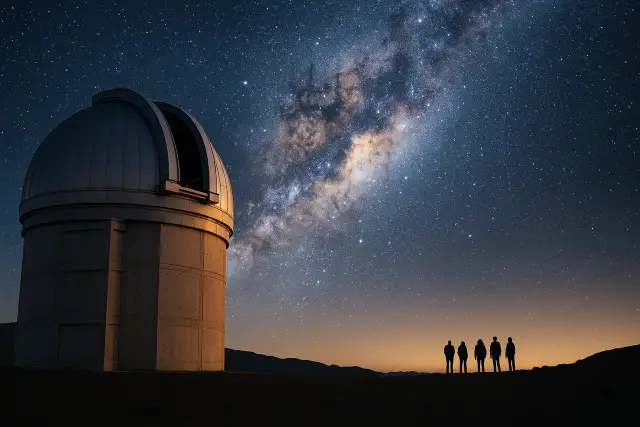
What is astrotourism in Chile and why is it so important?
Astrotourism in Chile is not just a recreational activity, but a profound experience that connects humankind with the cosmos. Thanks to its unique geographical conditions, our country has established itself as the world's leading destination for stargazing. The combination of an extremely dry atmosphere, minimal light pollution across vast areas of the country, and the large number of clear nights each year allows for visibility that is rarely found elsewhere on the planet.
For those seeking to understand the universe, Chile offers an infrastructure that blends cutting-edge science with special interest tourism. From the Atacama Desert to the Patagonian steppes, the Chilean sky acts as a window into the universe's past. This activity has grown exponentially, allowing both experts and amateurs to enjoy guided tours, educational talks, and the use of high-end telescopes at tourist observatories located throughout the country.
Furthermore, astrotourism fosters local development in rural areas, promoting the conservation of dark skies as a natural heritage that we must protect. If you're planning your next trip, knowing where to camp to see the clearest skies in Chile is an excellent starting point for experiencing this adventure authentically.
Why northern Chile has the best skies in the world
The technical reason behind Chile's astronomical supremacy lies in specific climatic and geographical factors. The presence of the Andes Mountains acts as a natural barrier, blocking moisture from the east, while the Humboldt Current in the Pacific Ocean stabilizes temperatures along the coast. This creates a temperature inversion that keeps clouds at low levels, leaving the northern peaks and plateaus with clear, stable skies.
In regions like Antofagasta and Atacama, it's common to have more than 300 clear nights a year. This atmospheric stability is what attracts international scientific consortiums to install the world's largest telescopes. For tourists, this translates into an almost absolute guarantee that, when booking an astronomical tour, they'll be able to observe planets, nebulae, and star clusters with astonishing clarity.
The phenomenon of atmospheric transparency
Transparency refers to the absence of dust and moisture particles in the air. In northern Chile, the air is so pure that starlight is not scattered, allowing celestial objects to be seen that would be invisible in cities or humid areas. This purity is vital for capturing long-exposure photographs, a very popular practice among visitors seeking to photograph the Milky Way in all its splendor.
When is the best time for astrotourism in Chile
Although observation is possible year-round, certain periods are more favorable for specific sightings. During the Southern Hemisphere summer (December to March), nighttime temperatures are more pleasant, especially in the highlands, although the far north can experience the so-called "Bolivian winter" with occasional rain. However, for many amateur astronomers, winter (June to August) offers the clearest skies due to the lower humidity, despite the intense cold.
It's essential to check the 2026 lunar calendar for Chile before planning your visit. New Moon nights are ideal for observing deep-sky objects like galaxies and nebulae, as the moon's brightness doesn't interfere with the darkness of the sky. Conversely, if you're interested in seeing the Moon's craters and mountains in detail, the days near the first quarter are best.
What are the best tourist observatories in the Coquimbo Region?
Known as the "Region of the Stars," Coquimbo is the birthplace of astrotourism in Chile. The country's first tourist observatory was inaugurated here, and a network of services has developed that includes themed hotels and restaurants offering dinners under the stars.
Mamalluca Observatory in Vicuña
Located a few kilometers from Vicuña, in the heart of the Elqui Valley, the Mamalluca Observatory is a pioneer in the field. It offers nighttime tours that include an introductory talk and observation through electronic and manual telescopes. It's ideal for families and those new to astronomy. Its proximity to the city makes it very accessible, although advance booking is recommended due to high demand.
Collowara Observatory in Andacollo
This center stands out for its modern architecture and strategic location atop Churqui Hill. Collowara offers a more intimate experience and features large-aperture telescopes that allow for stunning views of Saturn and Jupiter. Furthermore, the community of Andacollo has worked diligently to reduce urban light pollution in order to protect its night sky.
Pangue Observatory in the Elqui Valley
For those seeking a more personalized and technical experience, the Pangue Observatory offers guided tours led by astronomers or highly specialized guides. Unlike larger observatories, here the groups are small, allowing for more time spent in front of the telescope eyepiece and a deeper exploration of complex astrophysics concepts.
Where to see the stars in San Pedro de Atacama
San Pedro de Atacama is undoubtedly the epicenter of international tourism in northern Chile. Its altitude (2,400 meters above sea level) and desert climate make it a privileged location. In the surrounding area, there are numerous telescope sites offering high-quality astronomical tours.
Many of these tours begin with a naked-eye explanation, teaching about Western constellations and the Andean worldview, which identifies figures in the "dark patches" of the Milky Way, such as the llama or the toad. It's a fascinating way to understand how the ancient inhabitants of the desert interpreted the sky for their agricultural and ceremonial cycles.
[Image suggestion 1: A group of tourists observing through a professional telescope in the Atacama Desert under a bright Milky Way. Alt: Tourists doing astrotourism in Chile in the Atacama Desert]
What does the Andean worldview mean in Chilean astronomy?
Astrotourism in Chile is not just about modern science; it also recovers the ancestral knowledge of indigenous peoples such as the Likan Antay (Atacameño) and the Diaguita. For these cultures, the sky was a map and a calendar. Unlike Greek astronomy, which connects bright points to form figures, Andean astronomy focused on the interstellar clouds of dust that obscure parts of the galaxy.
Understanding these "dark constellations" allows visitors to connect with the history of the region. Many local guides incorporate these stories into their presentations, enriching the experience with legends about the origin of the sun, moon, and stars, adding invaluable cultural significance to the trip.
Great scientific observatories you can visit
Chile is home to approximately 40% of the world's astronomical observation capacity, a figure expected to reach 70% within the next decade. While these centers are primarily dedicated to professional research, some offer free daytime visits with prior registration.
- ALMA Observatory: Located on the Chajnantor Plateau, it is the world's largest ground-based astronomical project. Its 66 antennas work together to capture radio waves from the cold universe. Guided tours are usually offered on weekends and depart from San Pedro de Atacama.
- Paranal Observatory: Home to the VLT (Very Large Telescope), it is located south of Antofagasta. It is famous for its cutting-edge technology and for having been the setting for Hollywood films. Visits allow you to explore the control rooms and the engineering behind these giants of steel and glass.
- Tololo and Gemini South Observatories: Located in the Coquimbo Region, they are pillars of astronomy in the Southern Hemisphere. Visiting these sites allows us to appreciate Chile's importance in the search for answers about the origin of the universe and the existence of exoplanets.
Astrotourism in the central zone and the Cajón del Maipo
It's not strictly necessary to travel north to enjoy a beautiful sky. Near Santiago, the Cajón del Maipo offers hidden gems far removed from the glare of the capital. Tourist observatories like Roan Jasé and Pailalén Observatory combine astronomy with hiking and local wine tastings.
This option is ideal for those with limited time or who are in the capital for work and want a unique nighttime getaway. Furthermore, the city center boasts a growing selection of astronomical "glamping" options, where you can sleep in domes with transparent roofs and observe the stars from the comfort of your bed.
Practical tips for your first astronomical experience
To make your stargazing night perfect, it's important to consider a few logistical aspects. The desert and the mountains can be treacherous with the temperature once the sun sets.
- Dress in layers: Even in summer, desert temperatures can drop below 0°C. Wear thermal underwear, a windbreaker, a hat, and gloves.
- Avoid white lights: If you're going alone, use red light flashlights. White light constricts your pupils, and it can take up to 20 minutes for your eyes to adjust to the darkness and see the stars.
- Book in advance: The most famous observatories sell out weeks in advance, especially during holidays or when there are outstanding astronomical phenomena in Chile 2026 .
- Don't use flash: In night photography, flash is useless for capturing stars and will only ruin the experience for others.
[Image suggestion 2: A geodesic dome with a transparent roof, dimly lit on a starry night in the Elqui Valley. Alt: Astrotourism-themed accommodation in Chile's Elqui Valley]
The future of astrotourism and the protection of the skies
Chile faces the challenge of maintaining its leadership by protecting the darkness of its nights. Urban growth and the use of poorly oriented LED lights generate light pollution that affects both science and biodiversity. Foundations and government regulations are working to certify areas as "Starlight Reserves," guaranteeing that the sky will remain dark for future generations.
By choosing certified and environmentally conscious tour operators, travelers contribute to the sustainability of this industry. Astrotourism is an invitation to humility and reflection, reminding us of our small but special place in the cosmos. Whether you visit the far north or the reserves in the south, the Chilean sky awaits to reveal its most ancient secrets.
Astronomical events you can't miss in 2026
The astronomical calendar for 2026 promises to be exciting. Several meteor showers are expected, such as the Perseids and the Geminids, which are visible with unparalleled intensity under Chile's clear skies. In addition, planetary conjunctions between Venus, Mars, and Jupiter will offer visual spectacles that can be photographed even with basic equipment.
Planning your trip around these dates can transform a simple vacation into an unforgettable memory. Chile continues preparing to welcome thousands of enthusiasts who, year after year, look up to marvel at the infinite sky. Don't forget to check our website for constant updates on weather and events to ensure your astrotourism experience in Chile is everything you dreamed of.