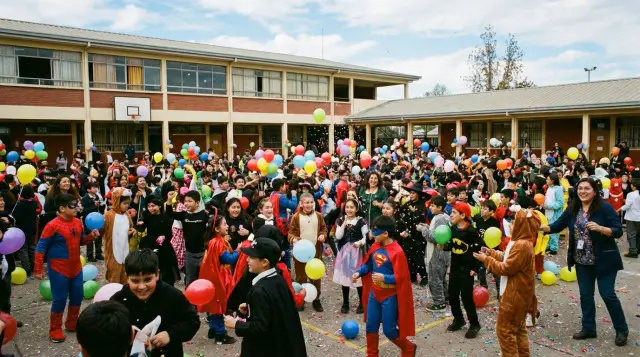
Every year, the school calendar in our country sets aside a special place for those who are the heart of our educational institutions. Student Day in Chile has become one of the most anticipated events for children and young people, transforming into a day where books and tests take a backseat to camaraderie, sports, and recreation. This day is not just a break from the academic routine, but a recognition of this formative stage and the active role students play in Chilean society. In the context of 2026, this celebration takes on particular significance. After years of transformations in the education system, Student Day presents itself as an opportunity to strengthen the bonds between teachers, administrators, and students. Similar to Teacher's Day in Chile , this day seeks to humanize the educational environment and remind us that learning also occurs through play, collective organization, and mutual respect. ## Why is Student Day Celebrated in Chile on May 11th? The choice of this date is not random and has a legal basis dating back to the 1990s. The origin of Student Day lies in the publication of Supreme Decree No. 147 of 1992, issued by the Ministry of Education. This official document established May 11th as the day to honor students, coinciding with the date on which the regulations allowing the creation of Student Centers in secondary schools were approved. Before this decree, student organization did not have such a robust legal framework to guarantee democratic participation within schools. The establishment of this commemoration was a symbolic and practical step towards civic education. The main objective was, and continues to be, to promote student organization, the expression of their opinions, and active participation in building their educational community. Since the start of the 2026 school year , many schools have begun planning for this date as a milestone of integration. ## The Historical Origin of Decree 147 of 1992 To understand the importance of this decree, we must go back to Chile in the early 1990s. The country was undergoing a process of transition and strengthening its democratic institutions. In this context, the Ministry of Education sought mechanisms to ensure that young people were not only recipients of knowledge, but also subjects with rights and the capacity for governance. The Student Council regulations allowed each school to have a board elected by its peers, fostering leadership and responsibility. Decree 147 not only established the day on the calendar, but also urged school authorities to provide spaces for students to develop cultural, artistic, and sporting activities. Over time, the celebration spread from secondary education to primary and preschool, becoming a cross-cutting celebration that encompasses the entire Chilean school system, from Arica to Punta Arenas. ## What Student Day Means to Chilean Students For a student in Chile, May 11th represents freedom and belonging. It's a day when roles become more flexible: it's common to see teachers in costume, preparing magic acts, dances, or theatrical performances for their students. This change in dynamics is fundamental for students' mental well-being, as it reduces the stress associated with exams and strengthens the sense of community. From a pedagogical point of view, Student Day is a tool for fostering positive school relationships. It allows students who may not excel academically to find a space to shine in sports, art, or event organization. Furthermore, for those in higher education who depend on government assistance, student life is experienced differently, but the spirit of recognition persists. It's important to remember that for many, the support of the BAES 2026 Scholarship and other social programs are part of that student identity that is celebrated at this time. ## Fostering School Coexistence and Identity School identity is built through shared milestones. Student Day acts as a social glue. When a school divides into alliances to compete in a healthy way, bonds of friendship are forged that often last a lifetime. School coexistence is not just about avoiding conflicts, but about creating positive experiences that make students feel proud of their uniform and their institution. In 2026, the focus shifted towards a more inclusive celebration. It's no longer just about physical competitions, but also talent shows, video game tournaments (e-sports), robotics workshops, and debate forums. The idea is that every student, regardless of their interests, feels part of the celebration. This diversity reflects the reality of today's Chilean youth: connected, diverse, and with multiple forms of expression. ## How Student Day is Celebrated in Chilean Schools Although each school has the autonomy to organize its day, there are traditions that are repeated throughout the country. Formal classes are usually suspended or reduced to a minimum to make way for an energetic schedule. Activities typically begin with a shared breakfast in each classroom, where parents and guardians often contribute typical foods to start the day off right. Later, the central courtyard becomes the main stage. Performances prepared by the teachers are usually the highlight of the morning. Seeing a math teacher dancing to the latest hit song or the principal participating in a scavenger hunt creates a sense of connection that breaks down traditional hierarchical barriers. These actions demonstrate that education is, above all, a human process. ## Common Recreational and Sports Activities The popular alliances are the driving force behind the celebration. Schools divide themselves by colors or themes (movies, countries, decades) and compete in various categories. Among the most common activities are: * **Sports competitions:** Indoor soccer, basketball, volleyball, and sack races. * **Flash Quizzes:** Quick challenges like finding a specific object or performing an improvised dance routine. * **Costume Parades:** Where the creativity of students and their families is put to the test with recycled materials or ingenious themes. * **Talent Showcase:** Spaces for singing, dancing, playing instruments, or even stand-up comedy. * **Food Fairs:** Sale of products to raise funds for study trips or charitable causes. ## The Role of Teachers and the Student Council The success of Student Day depends largely on the coordination between the faculty and the Student Council. Student leaders take a leading role in the planning, allowing them to put management, budgeting, and leadership skills into practice. It is one of the first experiences of representative democracy that young people have. For their part, teachers act as facilitators. Their job is to ensure that the activities take place in an environment of respect and safety. In many cases, teachers spend weeks secretly rehearsing their presentations to surprise their students. This effort is deeply valued by the students, who see in this gesture an act of affection and dedication that goes beyond teaching curricular content. ## Difference between Student's Day and Student's Day It is common for the terms to be used synonymously, but in the Chilean context there is a subtle semantic and cultural difference. The term student comes from the Latin 'alumnus', which means 'nourished', referring to someone who receives instruction. On the other hand, 'student' refers to someone who dedicates themselves to study on their own initiative. In Chile, the official May 11th holiday is called Student's Day, focusing mainly on the primary and secondary school community. However, in the university and technical-professional sphere, Student's Day is preferred, and the celebrations tend to be more closely linked to university autonomy and the assertion of social rights. Regardless of the name, the underlying message is the same: to celebrate the learning process and the transformative potential of education. ## Students' Rights and Responsibilities in the Context of this Celebration Student Day is also an opportune moment to remember that education is a fundamental right guaranteed by the State. In Chile, the General Education Law (LGE) establishes that students have the right to receive an education that offers them opportunities for holistic development. This includes not only academics, but also physical, artistic, and social development. Among the responsibilities, the celebration reinforces the importance of respect for peers and the entire educational community. A successful celebration is one where there is no room for bullying or exclusion. Schools take advantage of this date to promote student handbooks that ensure May 11th is a happy day for everyone, without exception. Participation in Student Councils is also a civic duty that prepares young people for adulthood. ## Impact of Technology on Current School Celebrations In 2026, technology has transformed how Student Day is celebrated. Social media plays a crucial role, allowing activities to be live-streamed for parents who cannot attend or to connect different campuses of the same school. TikTok contests, real-time digital trivia, and the use of apps to vote for the winning team are now part of the everyday landscape. However, the challenge for schools is to balance screen time with face-to-face interaction. Student Day aims to recapture physical contact, the cheers of the crowd in the playground, and the hug after winning a competition. Technology should be a complement that enhances creativity, not a substitute for the lived experience that defines this Chilean tradition. ## Recommendations for Organizing an Unforgettable Student Day For the day to be a success, planning should begin weeks in advance. Here are some key points that Chilean schools typically consider: * **Listen to the students:** Conduct preliminary surveys to find out what activities truly interest them. * **Safety first:** Have protocols in place for physical activities and ensure that food meets health and safety standards. * **Full inclusion:** Design games that allow the participation of students with reduced mobility or special educational needs. * **Sustainability:** Encourage the use of recycled materials for costumes and decorations, and ensure proper waste management after the celebration. * **Recognition:** Beyond material prizes, award diplomas or honorable mentions for values such as camaraderie, joy, and creativity. Student Day in Chile will continue to be a fundamental part of our school culture. It is an annual reminder that school is much more than four walls and a blackboard; it is a space for life, dreams, and the formation of the citizens who will lead the country in the future.
Student Day in Chile 2026: Why it\'s celebrated on May 11th and its importance in the school community
Te puede servir:
Consulta el calendario 2026 de Chile con todos los feriados oficiales, o revisa ya el calendario 2027 para planificar el próximo año.