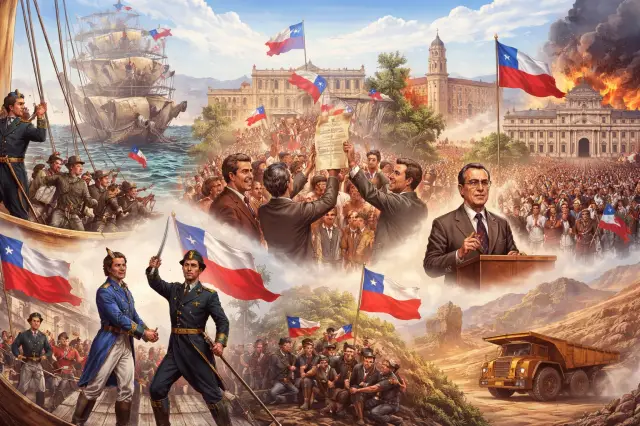
Chilean historical commemorations are an essential part of the national calendar, allowing us to remember the events, processes, and figures that shaped the country's course. Many of these dates are commemorated in schools, official ceremonies, and cultural activities, although not all are holidays. Understanding them in a simple way helps strengthen collective memory and historical knowledge, especially among students and the general public.
In the Chilean calendar, these commemorations are present throughout the year and often generate searches related to historical events, school projects, and educational content, as is the case with other articles available in
What are historical commemorations in Chile?
Historical commemorations are dates that recall relevant events from Chile's past , such as political processes, social events, cultural milestones, or key moments in the formation of the State.
Unlike holidays, these dates don't always mean time off work, but they do have strong symbolic and educational value. Many are included in the school calendar and official programs of the Ministry of Education.
These commemorations allow:
Reflecting on national history
Understanding the present through the past
Strengthening Chilean identity
Educating new generations
Main Chilean historical commemorations explained in a simple way
Below are some of the most important Chilean historical commemorations , explained in a clear and simple way, ideal for students, teachers and readers looking for direct information.
May 21st, Naval Glories Day
This date commemorates the Naval Battle of Iquique, which took place in 1879 during the War of the Pacific. In this engagement, the corvette Esmeralda, commanded by Arturo Prat , clashed with the Peruvian monitor Huáscar.
Although Chile lost the battle, Prat's sacrifice became a symbol of courage and patriotism. For this reason, May 21st is one of the country's most important historical commemorations and is widely taught in schools.
September 18th First National Governing Board
On September 18, 1810, the First National Governing Junta was formed, considered the beginning of Chile's independence process. Although independence was consolidated years later, this date marks the first step towards political autonomy.
February 12th Proclamation of the Independence of Chile
On February 12, 1818, the Independence of Chile was officially proclaimed in the city of Talca. This act confirmed the definitive separation from Spanish rule.
This historical commemoration is key to understanding the entire independence process and is usually less well known than September 18, although its historical relevance is fundamental.
April 5th, Battle of Maipú
The Battle of Maipú, fought in 1818, was decisive in securing Chilean independence. In it, the Army of the Andes, led by Bernardo O'Higgins and José de San Martín, definitively defeated the royalist forces.
This date is commemorated as a military and political milestone that consolidated national independence.
September 21st, Radio Day in Chile
This commemoration recalls the first radio broadcast made in Chile in 1922. Radio played a key role in the dissemination of information, culture and education, especially during the 20th century.
It is a historical commemoration linked to communication and is usually addressed in educational and cultural contexts.
September 4th Nationalization of Copper
September 4th marks the anniversary of the nationalization of copper in 1971, a process that allowed the Chilean State to take control of the country's main mineral wealth.
This event marked a turning point in the national economy and is one of the most important Chilean historical commemorations of the 20th century.
September 11, 1973 Coup d'état
On September 11, 1973, the coup d'état took place that overthrew President Salvador Allende and began the military dictatorship led by Augusto Pinochet.
It is one of the most complex and reflective commemorations on the Chilean calendar, associated with memory, human rights and the recent history of the country.
Importance of historical commemorations in education
Chilean historical commemorations play a key role in the education system, as they allow:
Teaching history in a contextualized way
Encourage critical thinking
Promote democratic values
Understanding social and political processes
For this reason, many of these dates are part of the school calendar and are addressed through events, projects, and educational activities, as detailed in other educational articles published in
Difference between commemoration and holiday in Chile
A common question in searches is the difference between the two concepts.
| Concept | Meaning |
|---|---|
| Historical commemoration | Recall a relevant event from the past |
| Holiday | Mandatory legal day of rest |
Not all commemorations are holidays, but all holidays have some historical, religious, or cultural origin.
How are historical commemorations chosen in Chile?
Historical commemorations are defined by laws, official decrees, and institutional agreements. Many are supported by the Ministry of Education, the Ministry of Culture, and other public entities.
Some dates have been maintained since the 19th century, while others were recently incorporated to recognize relevant social or cultural processes.
Why learn about Chilean historical commemorations?
Knowing about Chilean historical commemorations allows you to:
To better understand national history
To value social processes
Connecting past and present
Strengthening cultural identity
These dates not only belong in history books, but continue to influence the political, social and cultural life of the country.