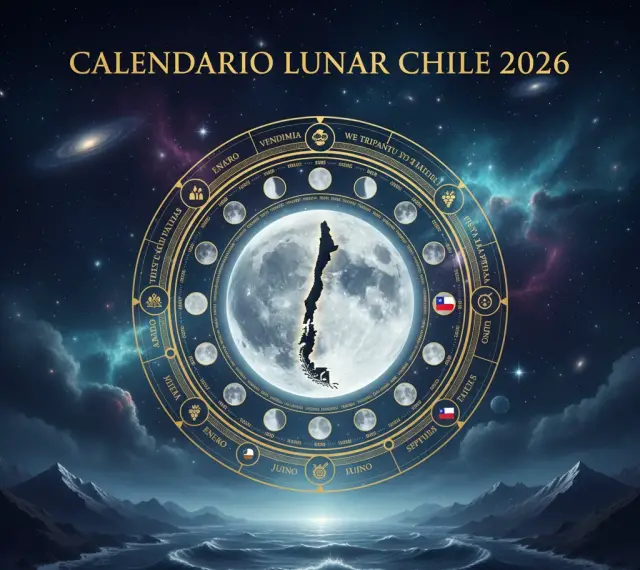
Chile boasts some of the clearest skies on the planet. From the Atacama Desert to Patagonia, looking up is part of our identity. However, by 2026, simply looking at the sky won't be enough; we need to know when to look.
Unlike other countries in the region, the Chilean Lunar Calendar 2026 has a critical feature: the time change . While lunar phases occur at a universal time, in Chile, our clocks move. This article is the only one you'll find optimized with the exact times for mainland Chile (Santiago) , taking into account the transition from summer time (UTC-3) to winter time (UTC-4) and vice versa.
Get ready for a year of astronomical events, spring tides for fishing on our coast and the key dates for pruning in your garden or vineyard.
Master Table: Full Moons 2026 in Chile (With Time Adjustment)
This year we will have 13 full moons . Please note the times, as they are calculated specifically for the Chilean time zone in effect each month.
| Month | Date | Time (Continental Chile) | Current Schedule | Traditional Name |
| January | January 3 | 7:03 AM | Summer (UTC-3) | Wolf Moon |
| February | February 1st | 7:09 PM | Summer (UTC-3) | Snow Moon |
| March | March 3 | 08:38 AM | Summer (UTC-3) | Worm Moon |
| April | April 2 | 11:12 PM | Winter (UTC-4) | Pink Moon |
| May | May 1st | 02:23 PM | Winter (UTC-4) | Flower Moon |
| May (Blue) | May 31 | 5:45 AM | Winter (UTC-4) | Blue Moon |
| June | June 30 | 8:57 PM | Winter (UTC-4) | Strawberry Moon |
| July | July 29 | 11:36 AM | Winter (UTC-4) | Stag Moon |
| August | August 28 | 01:18 AM | Winter (UTC-4) | Sturgeon's Moon |
| September | September 26 | 02:49 PM | Summer (UTC-3) | Harvest Moon |
| October | October 26 | 01:12 AM | Summer (UTC-3) | Hunter's Moon |
| November | November 24 | 11:53 AM | Summer (UTC-3) | Beaver Moon |
| December | December 24 | 10:28 PM | Summer (UTC-3) | Cold Moon |
Important Note Regarding the Time Change: It is estimated that on Saturday, April 4, 2026, clocks will be set back one hour (starting winter time) and on Saturday, September 5, 2026, they will be set forward (starting summer time). The table above already reflects these adjustments.
Lunar Phases 2026: Seasonal Details
In Chile, the seasons define our lives. Unlike in the tropics, here the moon accompanies marked cycles of cold, rain, and dry heat. Let's analyze the lunar year by seasons in the Southern Hemisphere.
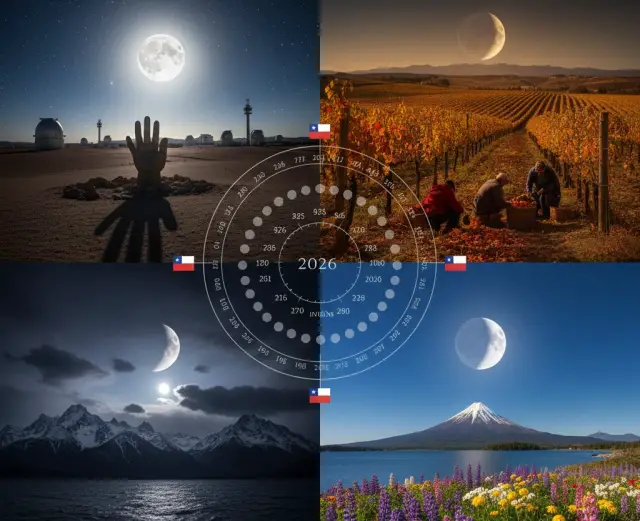
☀️ Summer (January - March)
The sky is clear in the central and northern areas, ideal for nighttime observation.
January: The Full Moon on January 3rd marks the peak of the holiday season. It's ideal for night fishing in southern lakes.
February: Month of early harvests. The waning moon in the middle of the month favors the making of homemade preserves.
March: A crucial astronomical month. We will have a lunar eclipse visible at dawn (more details below).
🍂 Autumn (April - June)
The days are getting shorter and the moon is beginning to dominate more hours of the day.
April: With the arrival of the "Pink Moon" and the change to daylight saving time, we gain daylight in the mornings but lose afternoons. It is the key month for the grape harvest in the central valleys.
May: The phenomenon of the year. May will have two full moons. The second, on May 31, is a "Blue Moon." Energetically, it's considered a "bonus" time to close cycles before winter.
June: The sacred month for our native peoples. The We Tripantu (Mapuche New Year) occurs with the winter solstice (June 21), under the watchful eye of the waxing moon in 2026.
🌧️ Winter (July - September)
Long, cold nights, perfect for observing the clear moon after the rain.
July: The "Deer Moon" shines over the snow-covered Andes Mountains, offering a unique photographic spectacle.
August: Month of cats and wind. The full moon of August 28th brings with it a partial eclipse perfectly visible throughout Chile.
September: The moon of the National Holidays. This year, September 18th will fall under a Crescent Moon, guaranteeing illuminated nights for the fondas (traditional Chilean food stalls).
🌸 Spring (October - December)
October and November: The full moon illuminates the flowering desert (if conditions allow) and marks the beginning of the strong planting season in the southern area.
December: Christmas with a Full Moon. On December 24th, the sky will be at its brightest, something that doesn't happen every year.
Eclipses 2026: What will we see from Chile?
Chile is eclipse country. Although we won't have a total solar eclipse like those of 2019 or 2020, 2026 offers us two lunar events that can be enjoyed with the naked eye.
1. Total Lunar Eclipse (March 3, 2026)
Visibility: Partial at dawn. This eclipse will be a challenge for early risers. It occurs just as the moon is setting on the western horizon (towards the sea) and the sun is rising over the mountain range.
The Phenomenon: Chile will see the beginning of the penumbral and partial eclipse.
Key time (Santiago): Around 6:50 AM, the moon's shadow will begin to be visible. The moon will set below the horizon while eclipsed.
Best place to see it: The coast (Valparaíso, La Serena), where the western horizon is clear towards the ocean.
2. Partial Lunar Eclipse (August 28, 2026)
Visibility: Excellent throughout the country. Unlike the one in March, this eclipse occurs in the middle of the Chilean night, with the moon high in the sky.
Schedule: The maximum of the eclipse will be after midnight (early morning of the 28th), around 00:15 AM (winter time).
What you'll see: Part of the moon will darken noticeably. It won't turn completely red, but the contrast will be evident. It's safe to view without special glasses.
Lunar Calendar for Chilean Farmers and Winegrowers 2026
Agriculture in Chile, especially biodynamic viticulture, is strictly governed by the lunar cycle. Here are the key points for 2026:
The 2026 Harvest (Grape Harvest)
To obtain wines with a higher concentration of aromas and that better withstand aging, it is recommended to harvest from Waning Moon to New Moon .
Suggested Dates: March 4-16 and April 3-15. Avoid harvesting on Full Moon days if you are looking for a wine with long aging potential, as the grapes contain too much water.
Winter Pruning
In Chile, the pruning of rose bushes, fruit trees and grapevines is done in winter.
Best time: Waning moon . This prevents the plant from "weeping" (losing sap) and helps it heal quickly in the face of frost.
Key Dates: June 30 to July 13 (Midwinter).
Vegetable Planting (Central and Southern Zone)
Fruits on the ground (Tomatoes, Pumpkin, Beans): Sow in the Waxing Crescent (September and October are key).
Root vegetables (potatoes, carrots, garlic): Plant during the waning moon . In Chiloé, potato planting is strictly observed during the waning moon to avoid pests.
Lunar Calendar for Hair 2026 (Seasonal Focus)
The dry climate of Santiago and the north, or the humidity of the south, affect your hair. The moon can help protect it.
Rapid Growth (Waxing Moon)
Ideal for repairing hair after summer sun damage.
Dates: January 25-31, February 24-28.
Strengthening and "Winter Cutting" (Full Moon)
In winter (June-August), hair tends to fall out more due to heat stress and wearing hats. Trimming the ends during a full moon strengthens the roots.
Golden Dates: June 30, July 29 and August 28.
Long-lasting hair removal (Waning Moon)
To have less hair by summer 2027, start your laser or wax hair removal sessions during the waning periods of spring 2026.
Dates: September 27 - October 10.
Fishing and Tides on the Chilean Coast
With over 6,000 km of coastline, knowing about tides is vital.
Spring tides: Occur during the New Moon and Full Moon . In Chile, take precautions on rocky areas during these phases, especially in winter due to high tides.
Best Fishing (Corvina, Sole): New Moon days are preferred by artisanal fishermen from Arica to Puerto Montt, as the darkness makes the fish rise to the surface and be less wary.
Frequently Asked Questions (FAQ) Chile
When do they change the clocks in Chile in 2026?
According to current regulations, winter time begins on the first Saturday of April (April 4th) by setting the clocks back one hour. Summer time returns on the first Saturday of September (September 5th) by setting the clocks forward one hour.
Will the 2026 solar eclipse be visible in Chile?
No. The total solar eclipse of August 2026 will be visible in Europe (Spain). However, in February 2026 there will be an annular eclipse in Antarctica that could have very low partial visibility in the far south of the Magallanes Region.
When is We Tripantu 2026?
The Mapuche New Year is celebrated during the winter solstice, between June 21 and 24. In 2026, this will coincide with a waxing moon, a symbol of germination.
2026 in Chile will be a year of "Extreme Moons": from coastal eclipses to a Blue Moon in the heart of autumn. Whether you use this calendar to plan your visit to an observatory in the Elqui Valley, to know when to prune your vines, or simply to connect with nature, remember that in our latitudes, the sky rules.
Bookmark this page, as we will update any official changes to the time change decrees that the government may announce.