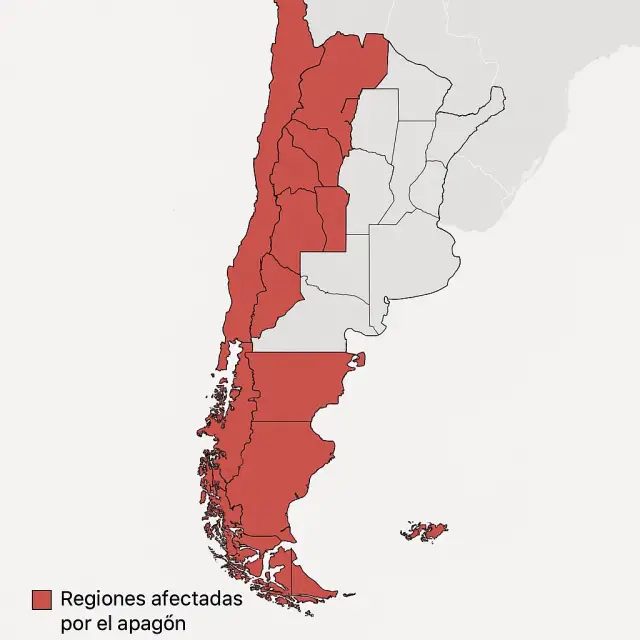
The massive blackout in Chile in February 2025 left millions of people without electricity from Arica to Punta Arenas. The event was one of the most extensive outages in the last 20 years and sparked a heated debate about energy security and dependence on the interconnected grid .
According to initial reports from the National Electric Coordinator (CEN) , the main cause was a failure in the 500 kV transmission line that connects the north with the center of the country , aggravated by extreme weather conditions in the north.
The automatic shutdown of generating plants to prevent overloading produced a domino effect that left almost 80% of the country without power. This phenomenon, technically known as "cascading collapse," was similar to the 2010 blackout, although with more widespread consequences.
Contributing factors included:
High seasonal electricity demand due to heat waves.
Insufficient maintenance at strategic substations.
Lack of redundancy in the main transmission lines.
Excessive dependence on the centralized National Electric System.
This episode served as a reminder of the urgency of diversifying the energy mix and strengthening the country's electrical infrastructure.
Regions most affected by the power outage
The blackout affected 13 of the country's 16 regions , with the greatest impact in the central region. Santiago, Valparaíso, O'Higgins, and Maule were without power for more than five hours, paralyzing traffic lights, banking services, and public transportation.
In regions such as Antofagasta and Tarapacá , mining companies reported temporary losses due to production chain disruptions. In the far south, recovery was faster thanks to local microgrids and diesel backup systems , demonstrating the usefulness of decentralized systems.
| Region | Average outage duration | Observations |
|---|---|---|
| Metropolitan | 4–6 hours | Metro collapse and digital services |
| Valparaíso | 5 hours | Rural drinking water system failure |
| Biobío | 3 hours | Phased replacement from local substations |
| Antofagasta | 6 hours | Temporary strike in mining operations |
| Magellan | 1 hour | Energy recovered from local plants |
Social and economic consequences of the blackout
The 2025 blackout highlighted the fragility of modern urban systems in the face of energy failures. In just a few hours , telecommunications networks, payment systems, transportation, and hospitals were brought to a standstill.
The most relevant consequences included:
Economic losses estimated at more than $120 million, especially in the industrial sector.
Suspension of classes and public services , impacting more than 2 million students.
Increase in road accidents due to the lack of operational traffic lights.
Emergency telephone lines were saturated , which complicated coordination among authorities.
At home, thousands of families had to resort to candles, portable batteries, and generators . On social media, images of Santiago in complete darkness went viral, sparking a debate about the technological dependence of today's society.
Lessons and challenges for the Chilean electrical system
The massive blackout of 2025 provided valuable lessons for Chile's energy future. The main one is the need to improve grid resilience and decentralization , integrating renewable energy with storage and local generation.
Among the measures that the government and the National Electoral Council subsequently announced were:
Complete review of the trunk transmission system , with prioritized investments in backup lines.
Implementation of regional microgrids that operate autonomously in emergencies.
Installation of large-scale battery systems in the north and center of the country.
Strengthening citizen communication protocols in the event of electrical emergencies.
Public education on energy saving and rational use , especially in summer.
Chile has made progress in incorporating clean energy sources such as solar and wind, but transmission infrastructure remains its weak point. Experts point out that the country must combine the energy transition with a national energy security strategy.
Impact on Chilean energy policy
Following the blackout, the Ministry of Energy announced the creation of a National Electrical Safety Commission , with the participation of universities, companies, and community organizations. The goal is to develop a 2030 plan to ensure operational continuity even in the face of extreme events.
Debate also opened on the new Electricity Transmission Law , which seeks to streamline investments and establish stricter penalties for maintenance failures.
The discussion connects with other current national issues, such as the water crisis and the transition to clean energy , addressed in previous blog articles such as "Climate Change in Chile and Its Impact on Water Resources" and "Solar Energy in the Atacama Desert: A Sustainable Future for Chile."
Citizens' perspective and trust in institutions
The massive blackout was not only a technical problem, but also a challenge to public trust . According to subsequent surveys, more than 60% of Chileans felt the authorities reacted too late, although they appreciated the transparency of the subsequent reports.
Citizen campaigns promoting responsible energy use emerged on social media, while local communities organized drills to respond to future contingencies.
The experience of the massive blackout in Chile in 2025 thus became a turning point: a reminder of the importance of investing in critical infrastructure, but also of educating the population to face crises calmly and with preparation.