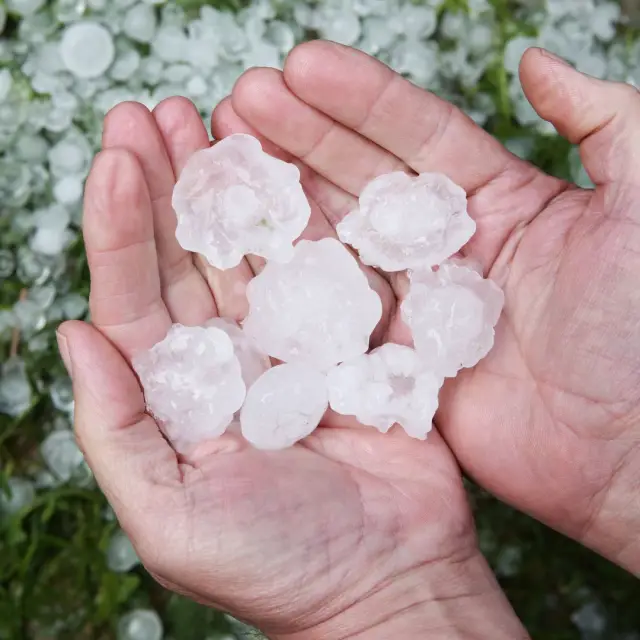
Hail is a fascinating and often shocking weather phenomenon that can cause anything from stunning to significant damage to property and crops.
What is Hail?
Hail is a form of solid precipitation that consists of balls or clumps of ice, called hailstones. Unlike snow or sleet, which forms from the freezing of water droplets in the atmosphere, hail develops under specific conditions within storm clouds, known as cumulonimbus clouds.
Hail Formation
The formation of hail is a complex process that involves several steps:
1. Storm cloud formation
The process begins with the formation of a storm cloud, typically a cumulonimbus cloud. These clouds develop under conditions of atmospheric instability, where warm, moist air rises rapidly. As the air rises, it cools and the water vapor condenses into liquid water droplets, forming the cloud.
2. Updrafts
Within the storm cloud, there are strong updrafts that carry water droplets toward the top of the cloud, where temperatures are much lower. In this upper region, temperatures can be well below freezing, allowing water droplets to freeze and form small ice particles.
3. Hail growth
Ice particles at the top of the cloud begin to fall due to gravity, but are caught again by updrafts and carried back to the top of the cloud. During this cycle of rise and fall, ice particles may encounter supercooled water droplets (liquid water droplets at temperatures below freezing). These water droplets freeze instantly upon contact with ice particles, causing hail to grow in size.
4. Repetitive cycle
The process of rising and falling can be repeated several times, allowing the hail to grow in size each time it collects more supercooled water droplets. The longer the hail stays inside the storm cloud, the larger it can become. Eventually, when hail particles are too heavy to be supported by updrafts, they fall to earth.
Factors Influencing Hail Size
The size of hail can range from small pellets to ice balls the size of baseballs or even larger. Several factors influence the final size of the hail:
1. Intensity of updrafts
Strong updrafts within the storm cloud are essential for the formation of large hail. The stronger these currents, the longer the hail particles can remain within the cloud, allowing them to grow larger.
2. Number of supercooled water droplets
The availability of supercooled water droplets in the cloud also plays a crucial role. The more water droplets that are present, the more opportunities the hail will have to grow in size as it collects and freezes them.
3. Duration of the storm
The duration of the storm also affects the size of the hail. Longer storms provide more time for hail particles to grow.
4. Storm cloud altitude
The height of the storm cloud is also an important factor. Cumulonimbus clouds extending to higher altitudes can harbor larger hail due to extremely low temperatures in the upper parts of the cloud.
Impact of Hail
Hail can have a significant impact on various areas, including agriculture, property, and personal safety.
1. Agriculture
Hail can cause severe damage to crops, destroying plants and fruits, and resulting in significant economic losses for farmers. Hail storms can devastate entire fields in a matter of minutes.
2. Property
Hail storms can also cause damage to property, including roofs, windows and vehicles. Large hail can pierce roofs, break windows and dent car bodies.
3. Personal security
Large hail can be dangerous to people, causing injuries if someone is outdoors during a hail storm. It is important to seek shelter immediately when a hail storm warning is issued.
Prognosis and Prevention
Hail forecasting is a challenge for meteorologists due to the unpredictable nature of hail storms. However, advances in radar technology and weather models have improved the ability to predict conditions favorable for hail formation.
1. Early warnings
Early warnings can help reduce damage and protect people. Meteorological services issue hail storm warnings when favorable conditions for its formation are anticipated. It is important that people heed these warnings and take steps to protect themselves and their property.
2. Protective measures
Protective measures may include covering vehicles, securing windows and roofs, and sheltering pets. In agricultural areas, farmers can use protective netting to protect crops from hail damage.
Hail is an impressive natural phenomenon that results from a complex atmospheric process. Although it can cause significant damage, understanding its training and preventive measures can help mitigate its effects. Meteorological science continues to advance, improving our ability to predict and respond to hail storms, protecting both people and their property.