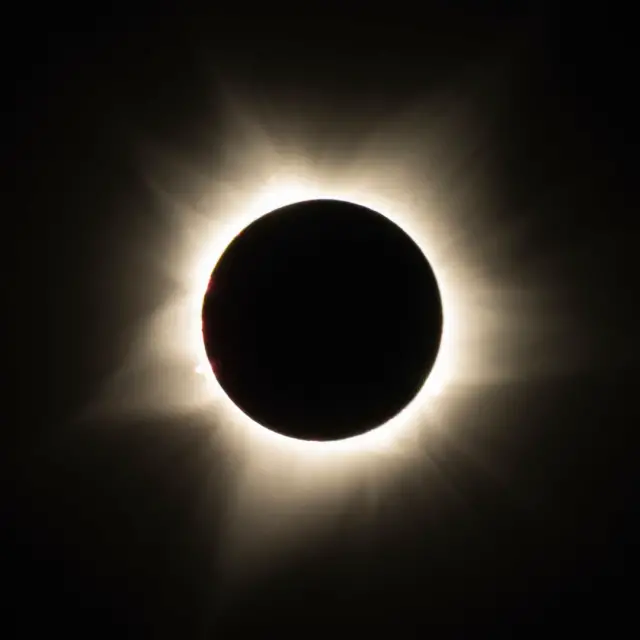
Since ancient times, the Sun has been a source of life and energy for Earth, but it can also be a source of danger. A solar storm or severe space weather event is a manifestation of this duality. It refers to a set of disturbances in space caused by solar activity that can affect technology and life on our planet. In this article we will explore what a solar storm is, how they form, their potential impacts, and the efforts being undertaken to mitigate their effects.
What is a solar storm?
A solar storm is a phenomenon that occurs when the Sun releases a large amount of energy in the form of charged particles , magnetic fields , and electromagnetic radiation . These storms can affect Earth in a variety of ways, from causing bright auroras at the poles to disrupting satellite communications or even damaging power grids.
Solar storms are related to solar flares and coronal mass ejections (CMEs) . Solar flares are explosions of energy on the surface of the Sun that can release radiation in all directions. A CME, on the other hand, is a gigantic cloud of plasma that is launched from the Sun's corona into interplanetary space, often in the direction of Earth.
How does a solar storm form?
The Sun is an active and complex star. Its surface is constantly changing due to the dynamics of the solar magnetic field . The energy accumulated in these magnetic interactions is sometimes released suddenly and violently, giving rise to solar flares and coronal mass ejections.
Solar flares : These occur when there is a reconnection of magnetic field lines in the solar atmosphere, releasing a massive amount of energy. The flares can last from minutes to hours, and emit radiation across the entire electromagnetic spectrum, from gamma rays to radio waves.
Coronal mass ejections (CMEs) : In these events, the Sun ejects a bubble of plasma and magnetic field into space. CMEs can take 1 to 3 days to reach Earth, depending on their speed. If the particle cloud and magnetic field accompanying the CME are directed toward our planet, the effects can be devastating.
Effects of a solar storm on Earth
The effects of a solar storm can vary depending on its intensity. While some storms cause only spectacular visual phenomena, such as the northern and southern lights, the most severe ones can have significant impacts on technological infrastructure and daily life.
1. Auroras
Auroras are the most visible phenomenon of a solar storm. When charged particles from the solar wind interact with the Earth's magnetic field, some of these particles are channeled toward the magnetic poles, where they collide with atoms in the atmosphere. This collision produces bright, colorful lights, known as auroras.
During an intense solar storm, auroras can be visible far beyond the poles. In extreme events, auroras have been seen at latitudes as low as Texas or the Caribbean, providing a stunning visual spectacle.
2. Interference in telecommunications
Solar storms can disrupt radio signals and satellite communications. This is especially problematic for aircraft, ships, and other systems that rely on high-frequency (HF) communications to stay in touch with their bases. GPS signals can also be affected, which could have implications for navigation, mobile applications, and aviation.
3. Damage to satellites and space technology
High-energy particles emitted during a solar storm can damage the electronic components of orbiting satellites. These systems, crucial for global communication, meteorology and Earth observation, are exposed to risks during extreme solar events. In the worst case, satellites can be disabled, potentially disrupting critical services such as weather forecasting and global telecommunications.
4. Effects on electrical networks
The most feared impact of a severe solar storm is the possibility that it could cause power grid failures. Coronal mass ejections can induce geomagnetic currents in the Earth, which can cause overloads in transformers and other components of the electrical system. A strong enough event could leave large areas of the planet without electricity for weeks or even months.
A famous example is the Carrington event of 1859, one of the largest solar storms on record. At the time, the impact on Earth was so strong that it disrupted the operation of telegraphs around the world and produced auroras visible at very low latitudes. If a similar storm were to occur today, its effects could be devastating given our reliance on technology.
5. Danger for astronauts and flights
Astronauts on the International Space Station (ISS) and other space missions are at risk during a solar storm, as they are outside the direct protection of Earth's magnetic field. High-energy particles can damage their equipment and expose them to dangerous levels of radiation. Additionally, flights crossing polar regions may also be at risk, as radiation in those areas can be more intense during a solar storm.
How frequent are solar storms?
The solar cycle lasts about 11 years, during which the Sun goes through phases of maximum and minimum activity. During solar maxima , solar storms are more frequent due to the greater number of sunspots and intense magnetic activity.
Although most solar storms do not pose a serious threat, a major storm does occur every few centuries. In 2012, an extremely powerful CME narrowly missed Earth, but fortunately missed it. Had it reached our planet, the effects would have been comparable to the Carrington event of 1859.
Monitoring and predicting solar storms
Technological advances have allowed scientists to monitor the Sun in great detail and better predict solar storms. Institutions such as NASA , the National Oceanic and Atmospheric Administration (NOAA), and the European Space Agency (ESA) continually observe the Sun for signs of activity that could lead to solar storms.
Solar monitoring satellites : Missions like the Solar and Heliospheric Observatory (SOHO) and the Solar Dynamics Observatory (SDO) allow scientists to observe sunspots, flares, and CMEs in real time.
Space Weather Prediction : Advances in space weather modeling have improved predictions of the impacts of solar storms on Earth. Although it is difficult to predict exactly when a solar storm will occur, scientists can now anticipate potential effects with greater accuracy.
Contingency plans : In response to growing concerns about severe solar storms, some governments and businesses are developing plans to protect critical infrastructure. This includes measures to harden power grids and establish emergency protocols in case a solar storm causes significant disruptions.
Are we prepared for a major solar storm?
Although the technology for monitoring and predicting solar storms has improved considerably in recent decades, humanity remains vulnerable to a major event. Global interconnectedness and our increasing reliance on technology make the impact of a major solar storm potentially devastating.
A major concern is that many countries’ power grids are not adequately prepared to withstand the effects of a severe solar storm. Repairing damaged transformers could take months, leaving large areas without electricity for extended periods. The lack of power would affect access to water, food, telecommunications and other essential services.