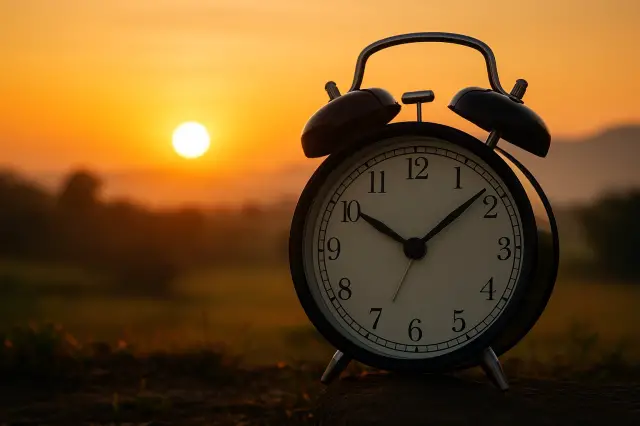
The 2026 time change in Chile is once again at the center of public debate. For more than a decade, this measure has divided opinions between those who highlight its benefits in energy efficiency and those who denounce its negative effects on health and productivity.
According to the Ministry of the Interior, Chile currently maintains a dual system with winter and summer time , applied differently to the mainland territory and the Magallanes Region, which maintains a fixed time throughout the year.
In the 2026 calendar, the time change is projected for the first Saturday of April and the first Saturday of September , following the pattern of recent years, although always subject to confirmation by official decree.
To find out the updated settings, you can visit the sections on important dates and events at CalendarioChile.com/blog , where upcoming changes and national holidays are published.
Why does Chile change its clocks?
Daylight Saving Time was originally implemented as an energy-saving measure. By adjusting clocks to make better use of natural sunlight , the aim was to reduce electricity consumption during peak hours.
However, over time, social habits, technology, and work patterns have changed, so many experts question whether this system is still necessary.
Main objectives of the time change
Energy savings in lighting and heating.
Greater use of natural light in the afternoons.
Synchronization with international time zones for commerce and telecommunications.
Reduction of consumption during peak hours.
Despite these theoretical benefits, recent studies show that the actual impact on energy consumption is decreasing due to the use of LED light bulbs and the automation of electricity consumption.
Effects of the time change on health
One of the most discussed aspects of the 2026 time change in Chile is its impact on physical and mental health .
The sudden change in time disrupts the biological clock , especially in children, older adults, and people with sleep disorders. Among the most reported effects are:
Morning fatigue during the first few days after the change.
Difficulty falling asleep.
Decreased school and work performance.
Increased stress and irritability.
Alterations in eating and digestion.
Several studies from the University of Chile and the Public Health Institute recommend reviewing the measure, especially in the southern regions, where exposure to sunlight during the winter is much lower.
What do Chileans think about the time change?
Surveys conducted in recent years show a clear division.
According to a survey by the Ministry of Energy, about 65% of Chileans prefer to maintain a single time zone throughout the year , arguing that the benefits of the change are minimal compared to the inconveniences it generates.
On social media, the topic becomes a trending topic every March and September, with diverse opinions ranging from humorous criticism to concern for the health of school-age children.
Arguments in favor of maintaining a single schedule
Greater stability in family routines.
Fewer sleep disturbances.
Better adaptation of schoolchildren and workers.
It facilitates coordination between regions.
Arguments in favor of the current system
Making use of natural light in summer.
Extension of afternoon recreational activities.
Synchronization with other countries in the southern hemisphere.
The political and technical debate surrounding the time change
The National Congress has discussed the elimination of daylight saving time several times.
Some members of parliament have proposed keeping winter time all year round , while others defend the current mixed model.
The Magallanes and Chilean Antarctic Region serves as an example: since 2017 it has maintained summer time permanently, with results valued by a large part of its population.
The Ministry of Energy, for its part, has indicated that the decision must be based on scientific criteria , considering factors such as:
Effective hours of sunlight.
Impact on sleep and performance.
Measured energy efficiency.
Economic coordination with neighboring countries.
How to prepare for the 2026 time change
Although it may seem like a minor measure, adapting correctly can make a difference in well-being and productivity.
Here are some practical tips recommended by chronobiology specialists:
Set your clocks forward or backward the night before to avoid confusion when you wake up.
Adjust your routines gradually in the days leading up to the event, especially regarding meal and sleep times.
Avoid bright screens before bed to help regulate your circadian rhythm.
Take advantage of the natural light in the morning by going for a walk or letting the sun in.
Maintain a light diet and avoid excessive caffeine during the first few days of the change.
When will the next time change be in Chile?
According to the current pattern, the estimated dates for the time change in Chile in 2026 would be:
| Change | Estimated date | Adjustment | Schedule type |
|---|---|---|---|
| Autumn | Saturday, April 4, 2026 | Delay by 1 hour | Winter time begins |
| Spring | Saturday, September 6, 2026 | Advance 1 hour | Daylight Saving Time begins |
These dates must be confirmed by decree of the Ministry of the Interior, usually published at the end of March and August of each year.
You'll find the official update at CalendarioChile.com/blog as soon as it's announced.