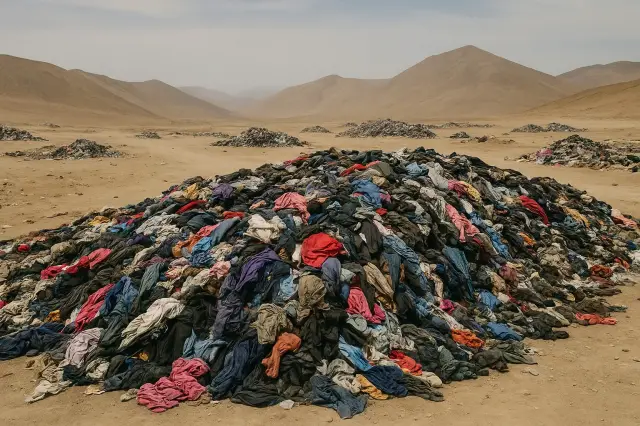
The issue of textile waste in Chile has gained momentum in recent years. The country has become a global focal point due to the enormous volume of discarded clothing that ends up in the north, especially in the Atacama Desert , where thousands of tons of garments from the fast fashion industry accumulate.
This situation prompted the creation of new regulations for textile waste aimed at addressing one of the most serious environmental challenges of the last decade. But its impact is not limited to the ecosystem: it is also transforming consumer culture, the fashion industry, and the environmental awareness of Chileans.
In this article from CalendarioChile.com/blog we will explore what the law says, how it affects the textile sector and what new opportunities arise from this crisis.
What does the new textile waste law in Chile establish?
The regulations are framed within the Extended Producer Responsibility (EPR) Law , which obliges companies to take charge of the entire cycle of their products, from their manufacture to their final disposal.
In the case of the textile sector, this means that importers, manufacturers and distributors of clothing will have to implement collection, recycling and reuse systems.
Key points include:
Prohibition of abandoning textiles in landfills or sending them to desert areas.
Creation of collection and sorting centers for used or unused clothing.
Tax incentives for companies that use recycled materials.
National educational campaigns on responsible consumption and the circular economy.
This regulation is inspired by models applied in the European Union, adapted to the Chilean reality, where the impact of fast fashion is particularly visible.
The problem of textile waste in the Atacama Desert
Chile is one of the largest recipients of used clothing in Latin America. Each year, more than 60,000 tons of clothing enter the country, largely from the United States, Asia, and Europe. Only a fraction is sold in the informal market; the rest ends up in illegal dumps in the Tarapacá Region .
The Atacama Desert has become a global symbol of this environmental crisis. Satellite images show mountains of clothing visible from space. These garments, made with synthetic fibers, can take up to 200 years to decompose , releasing microplastics and polluting the soil and air.
The Guardian 's 2025 report brought the issue back to the international agenda, highlighting Chile's role as a pioneer in legislating against the impact of textiles.
👉 You can read more about national environmental issues at CalendarioChile.com/blog .
How does regulation affect the fashion industry in Chile?
The new regulations require a redefinition of the textile business model . Major brands will have to invest in traceability, certifications, and sustainable processes.
Local businesses, for their part, have seen this as an opportunity to innovate and position themselves as conscious brands . There are already examples of workshops producing clothing with recycled fabrics, natural dyes, or on-demand tailoring systems to reduce waste.
In this new scenario, sustainable fashion ceases to be a trend and becomes a legal and cultural requirement.
The cultural shift towards responsible consumption
Beyond regulation, Chilean society is experiencing a profound cultural change .
More and more consumers are choosing:
Buy less and buy better quality.
Swap clothes at fairs or on digital platforms.
Participate in textile repair and recycling workshops.
This phenomenon reflects a growing environmental awareness, especially among young people who associate fashion with identity, creativity, and social responsibility.
The influence of global movements such as “Fashion Revolution” and the rise of national designers committed to sustainability have strengthened this trend.
Environmental impact and expected benefits
According to projections from the Ministry of the Environment, full implementation of the law could reduce the amount of unmanaged textile waste by 70% by 2030.
Among the expected benefits are:
Reduction of CO₂ emissions from textile production.
Reduction of microplastics in aquatic ecosystems.
Recovery of materials for new industrial uses.
Creation of green jobs in logistics, recycling and sustainable design.
In addition, Chilean universities and technology centers are beginning to develop textile innovation projects , such as biodegradable fibers or composting systems for natural fabrics.
Outstanding challenges and future opportunities
Despite the progress, the country faces key challenges:
Lack of infrastructure to process large volumes of textiles.
Need for ongoing civic education.
High initial costs for small businesses in the sector.
However, Chile could become a Latin American benchmark for sustainable textile management , exporting environmental knowledge and technology.
Public and private support will be crucial to turning regulation into a true cultural and economic transformation.
Chile as a leader in circular economy
Regulating textile waste is part of a broader strategy towards a circular economy , which seeks to reduce waste and extend the lifespan of products.
The national goal for 2040 is for 100% of priority waste to be recovered and not end up in landfills. This includes not only textiles, but also packaging, oils, tires, and electronics.
Chile is moving towards a more sustainable development model, where fashion, culture and the environment converge in a new way of understanding progress.