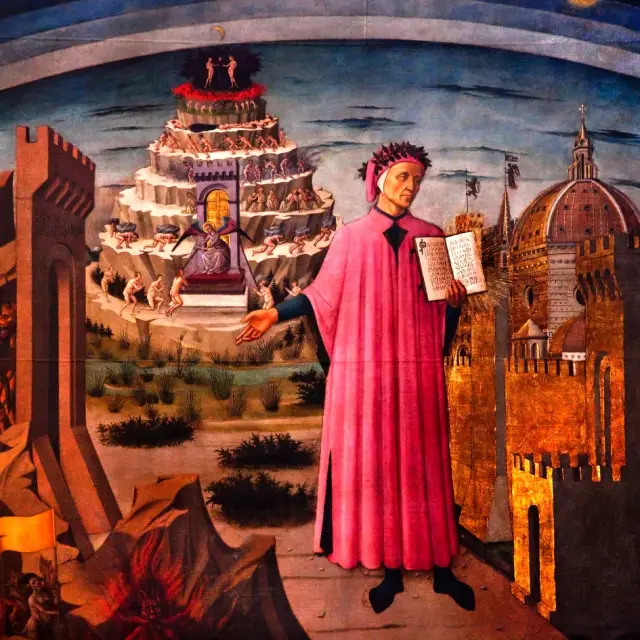
The Divine Comedy , written by Dante Alighieri between 1304 and 1321, is one of the most influential literary works in history. This epic poem, composed of three parts — Inferno , Purgatorio and Paradiso — depicts Dante’s allegorical journey through the afterlife, guided by the Roman poet Virgil and, later, by Beatrice, the love of his life. It is much more than a narrative; it is a profound reflection on the human condition, spirituality, ethics and salvation.
Throughout this article, we will explore the historical context of the work, its main themes, structure, symbolism and legacy, citing reliable sources to enrich our understanding.
Historical and cultural context.
Dante wrote The Divine Comedy during his exile in Florence, a time of intense political and social conflict in Italy. This context had a profound influence on the work, as the author not only addresses spiritual themes, but also political and moral issues of his time.
The work reflects the medieval worldview, deeply influenced by Christian theology and scholastic philosophy. In it, Dante not only aims to explore the afterlife, but also to offer a social and political critique of his time.
(Source: Encyclopedia Britannica )
Structure of The Divine Comedy.
The work is composed of 100 songs divided into three canticles:
- Hell: 34 cantos, including an introductory prologue. It represents the place of eternal punishment for sinners.
- Purgatory: 33 cantos. It is a place of purification for souls that will eventually reach Paradise.
- Paradise: 33 songs. The final destiny of souls who have attained divine grace.
Each canticle reflects an aspect of medieval thought: punishment, redemption and eternal reward, respectively. In addition, the structure of the poem follows a strictly mathematical scheme based on the number three, a symbol of the Holy Trinity.
(Source: History.com )
Main themes.
1. Divine justice.
One of the central themes of The Divine Comedy is divine justice. Each soul in Hell, Purgatory or Paradise receives its fate according to its actions in life, in accordance with the Christian notion of retribution.
For example, in Hell, sinners are punished in proportion to their sins, an idea known as "contrapaso." Thus, the lustful are buffeted by relentless winds that symbolize their lack of control in life.
2. Love.
Love is another driving force in the work. Beatrice, Dante's platonic love, is his guide in Paradise and represents the divine love that leads the soul to God.
3. Knowledge and reason.
Virgil, who guides Dante through Hell and Purgatory, symbolizes human reason. However, Dante can only reach Paradise through Beatrice, suggesting that reason has limits and that faith is necessary to achieve salvation.
(Source: SparkNotes )
Symbolism in The Divine Comedy.
The work is loaded with symbolism, which makes it a deeply allegorical text:
- The dark forest: Represents sin and moral confusion.
- The three animals (leopard, lion and wolf): They symbolize different types of sin: lust, pride and greed.
- The number three: It is a recurring symbol that alludes to the Trinity and is reflected in the structure of the poem, the rhymes and the themes.
Each element of Dante's journey has a symbolic meaning that enriches the narrative and provides multiple levels of interpretation.
(Source: CliffsNotes )
Analysis of the chants.
Hell.
Hell is a grim place divided into nine circles, each designated for a specific type of sin. Dante depicts tormented souls in scenarios that reflect their transgressions. This portrayal of eternal punishment is not only striking for its realism, but also for its ability to convey moral lessons.
Purgatory.
Purgatory is a mountain divided into seven terraces, representing the seven deadly sins. Here, souls are purified before entering Paradise. This section reflects hope and redemption, in contrast to the dark tone of Hell.
Paradise.
In Paradise, Dante ascends through nine heavens, guided by Beatrice. Each heaven corresponds to a heavenly virtue, such as faith, hope, and charity. The journey culminates with the vision of God in the Empyrean, a moment that represents the perfect union between the human soul and the divine.
(Source: The Divine Comedy - Columbia University )
Legacy of The Divine Comedy.
The impact of The Divine Comedy is incalculable. Its influence extends beyond literature, reaching into areas such as theology, philosophy, art and popular culture. Authors such as TS Eliot, Jorge Luis Borges and Umberto Eco have acknowledged the work as a source of inspiration.
In art, Gustave Doré's illustrations based on the poem have helped bring Dante's imagery to life, while in music, composers such as Franz Liszt have created works inspired by the work.
Furthermore, The Divine Comedy remains a relevant text today, studied in schools and universities around the world, and used as a tool to explore universal themes such as morality, justice, and human purpose.
(Source: BBC Culture )
The Divine Comedy is more than a poem; it is a spiritual and philosophical journey that explores the depths of the human soul. Dante not only describes the afterlife, but also offers an incisive critique of his time, full of reflections that remain relevant today.
Reading and studying this work is an experience that invites introspection and questioning of our own choices and values. Its legacy endures as a reminder of art's ability to capture the essence of humanity.
Sources: