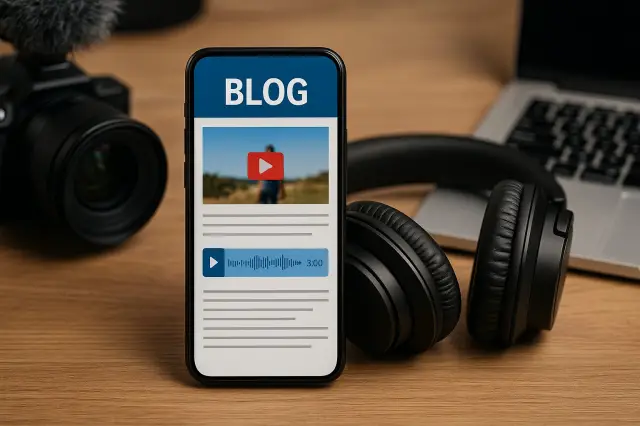
Multimedia content has become the heart of the most successful digital strategies. In Chile and around the world, blogs that integrate video, audio, and infographics capture more attention, increase time spent on the site, and improve their SEO ranking. It's no longer enough to simply write well: you have to show, tell stories, and evoke emotion with different formats .
This trend not only responds to technological evolution, but also to the new consumption habits of Chilean users, who increasingly prefer visual, short and easy-to-share content .
Why multimedia blogs are key to SEO in Chile
SEO has changed drastically. Google prioritizes user experience , and that includes offering dynamic, useful, and visually appealing content. Blogs with integrated images, videos, or podcasts achieve the following:
Reduce the bounce rate , because the visitor spends more time interacting.
Improve the site's authority by including original, proprietary resources.
Increase the CTR (Click Through Rate) in search results, as video and image previews stand out more.
Promote the indexing of different formats in Google Images, YouTube, and Google Podcasts.
In the case of CalendarioChile.com/blog , which covers cultural, tourist and educational topics, these formats offer the opportunity to showcase Chile in action : its celebrations, landscapes and local voices.
How to integrate video into your blog without losing speed or SEO
Video is the star format of content marketing. However, many blogs make the mistake of embedding large files or using unoptimized platforms.
To achieve effective integration:
Use YouTube or Vimeo to host your videos. This prevents slowing down your server and maintains good speed.
Add subheadings and descriptions with keywords. This improves SEO and accessibility.
It includes explanatory or testimonial videos on cultural, tourism, or educational topics. For example:
A short video showing how National Holidays are celebrated in different regions.
A clip of interviews with teachers about the importance of Teacher's Day in Chile .
Optimize the size and format (MP4, compression with tools like HandBrake or TinyVid).
Additionally, you can complement the video with descriptive text and links to other articles, such as:
👉 How to celebrate September 18th in Chile or Chilean cultural events of the year .
SEO fact: According to HubSpot studies, an article with video is 53% more likely to appear on the first page of Google.
Podcasts and audio embedded in blogs to connect with your audience
The podcast format is experiencing a sustained boom in Chile. Platforms like Spotify and Apple Podcasts show that Chileans are increasingly listening to informative and cultural content while commuting or during their daily activities.
Integrating audio into your blog has multiple benefits:
Increase accessibility : allow users to "listen" to your content while doing something else.
It creates a more human connection with the voice of the author or local guests.
It fosters brand retention and recall , because the voice generates emotional closeness.
How to use audio on your blog
Record a narrated version of the article for users with visual impairments or who prefer to listen.
Create micro-interviews with local historians, artists, or entrepreneurs.
Use sound fragments : folk music, natural environments, or recordings of traditional celebrations.
For example, in an article about Cultural Heritage Day , you could include a short audio recording with stories from people who participated in the event or typical sounds from monuments and cultural spaces.
This transforms your publication into a sensory and educational experience , ideal for content like that of CalendarioChile.com .
Infographics and data visualizations that increase engagement
Infographics remain one of the most powerful tools for capturing attention and generating external links. In Chile, readers especially value pieces that summarize complex information in a clear and visual way.
Keys to creating effective infographics
Use colors associated with your brand or national theme , such as red, blue, and white.
Simplify the information and highlight relevant figures (for example, how many people visit Chile during the National Holidays or how many regions celebrate a certain anniversary).
Include your logo and blog URL to reinforce your brand when the infographic is shared.
Name the file with keywords (example: “infographic-ephemerides-chile-2025.png”).
Additionally, you can link to related articles such as September Historical Events in Chile to strengthen internal SEO.
Bonus tip: Turn your infographics into short animated videos using tools like Canva or Lumen5. This will multiply their reach on social media.
Multimedia content distribution strategy
Publishing is not enough. The success of multimedia formats also depends on their intelligent distribution .
Practical recommendations
Share your videos on YouTube Shorts and link to them from your blog.
Upload your podcasts to Spotify and embed the player in the article.
Use Pinterest and Instagram to share infographics or visual snippets.
In your subscribers' emails, include a direct link to the multimedia content to increase recurring traffic.
Each format feeds into the other: video attracts new readers, audio builds loyalty, and infographics help with sharing. This synergy is what defines successful blogs in 2025 .
Recommended tools for creating multimedia content in Chile
Here are some useful and accessible platforms:
| Format type | Recommended tool | Key features |
|---|---|---|
| Video | CapCut / Canva Video / Lumen5 | Easy editing, automatic subtitles, social media templates |
| Audio | Anchor / Audacity / Soundtrap | Free recording, editing and distribution of podcasts |
| Infographic | Canva / Piktochart / Venngage | Visual templates and high-resolution export option |
| Optimized images | TinyPNG / Squoosh | Lossless compression to improve site speed |
These tools allow you to produce professional quality content without extensive technical resources, ideal for projects like the Chile Calendar , focused on educating, informing and entertaining.
Common mistakes when using multimedia content in blogs
While diverse formats are an advantage, their incorrect use can harm site performance. Avoid:
Uploading files that are too large and slow down the loading process.
Do not use alternative text (alt text) in images and videos.
Forgetting the copyright of audio or photographs.
Not adapting the content for mobile devices, where most Chilean users browse today.
Remember that quality is more important than quantity . One short, well-produced video is better than several poorly edited ones.
How to measure the impact of your multimedia formats
All multimedia content should have clear evaluation metrics. Use tools like Google Analytics 4 or Hotjar to find out:
Average time spent on page.
Percentage of video playback.
Clicks on the audio or play button.
Shared links and infographic downloads.
You can also conduct quick polls on social media, asking your readers what type of content they prefer. This allows you to continuously adjust your strategy.