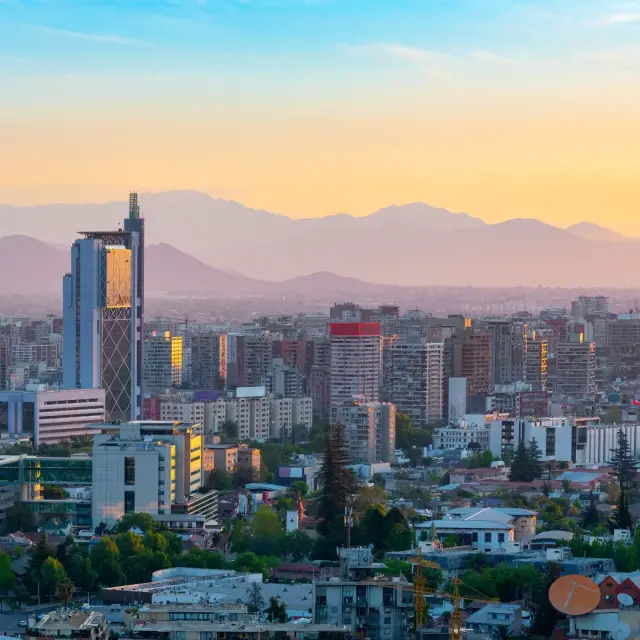
Santiago de Chile is the political, economic and cultural capital of the country, but why was this city chosen as the seat of national power? Throughout history, several geographical, historical and social reasons contributed to Santiago becoming the capital of Chile.
The founding of Santiago
The history of Santiago as the capital of Chile dates back to the 16th century, when the Spanish conquistador Pedro de Valdivia founded the city on February 12, 1541. The geographical location of the city was key to its selection as the capital, since the Mapocho River valley, where it was located, offered favorable conditions for agriculture and livestock, essential factors for the subsistence of the population at that time.
The site where Santiago was founded not only had fertile land, but also offered a natural defense. The Andes mountain range to the east, Santa Lucía Hill (called Huelén by the indigenous people) in the center, and proximity to the west coast provided strategic protection. In addition, the Mapocho River bisected the city, which offered additional advantages in terms of transportation and access to water, although it was also a source of periodic flooding in its early years.
Geographical and strategic factors
One of the key factors that influenced the choice of Santiago as the capital of Chile is its central location in the country. The city is situated roughly in the centre of Chilean territory, which facilitated communication and control of both the mineral-rich areas to the north and the fertile lands to the south. Being relatively close to the coast, Santiago was also connected to the port of Valparaíso, allowing for rapid export of goods and access to international trade.
Santiago's geographical centrality allowed it to become a centre of political and economic power over time. In early colonial times, many of the trade routes linking the north and south of the country passed through the city, consolidating its importance. With the construction of roads and railways during the 19th century, this strategic position was further strengthened.
Spanish colonization and the consolidation of the capital
Following the founding of Santiago, the city slowly began to develop as the administrative center of the Captaincy General of Chile, a dependency of the Viceroyalty of Peru. During the early colonial years, Santiago faced significant challenges, including indigenous attacks, earthquakes, and relative isolation compared to other larger viceregal capitals such as Lima or Buenos Aires. Nevertheless, the city remained the center of power in Chile.
Throughout the 18th century, with the increase in economic activity and agricultural expansion in the Central Valley, Santiago began to consolidate itself as the main urban centre of the country. It was during this period that important public and religious buildings were built, such as the Santiago Cathedral and the La Moneda Palace. The latter, originally conceived as a mint, would become the seat of executive power after independence.
The independence of Chile and the consolidation of Santiago
With Chile's independence in 1818, Santiago remained the country's capital, mainly due to its infrastructure and central position. At the time, Chile was facing numerous challenges, including internal and external conflicts, so it was crucial that the seat of government be in a location that could be easily defended and at the same time be accessible from different parts of the territory.
The establishment of the government in Santiago helped consolidate its position as a political center. During the first half of the 19th century, Santiago experienced accelerated growth as new governmental, educational, and religious institutions were built. The city also became the heart of military activities during the Wars of Independence, reinforcing its role as capital.
Economic and urban expansion
During the 19th century, Chile experienced a process of economic expansion driven by the exploitation of resources such as saltpeter, copper, and agriculture. Santiago became the epicenter of these activities, as many of the country's key economic decisions were made from the city. This led to significant population growth, and over time, the city began to expand into the surrounding areas.
The construction of new infrastructure, such as the railway that connected Santiago with other regions, helped strengthen its position as the capital. Important financial and commercial institutions were also established, attracting entrepreneurs and merchants from other parts of the country and abroad.
In the late 19th and early 20th centuries, Santiago developed into a modern city, with public services such as drinking water, electricity and public transport. Urbanisation and industrial growth led to an increase in population, further consolidating its status as the economic and political capital of Chile.
Cultural and educational development
Throughout the 20th century, Santiago not only established itself as the economic and political centre of Chile, but also as the cultural and educational centre of the country. The creation of universities, museums, theatres and cultural centres transformed the city into the intellectual heart of the nation. The University of Chile, founded in 1842, and the Pontifical Catholic University of Chile, founded in 1888, are two of the main institutions that contributed to the educational and cultural development of Santiago.
In addition, the city began to attract writers, artists and academics, helping to consolidate its role as the epicentre of Chilean cultural life. Over time, Santiago became the main stage for the country's most important cultural events, from music and theatre festivals to art exhibitions and literary events.
Santiago today
Today, Santiago remains the undisputed capital of Chile. The city is home to the seat of government, including the Presidency of the Republic, the National Congress, although the latter was partially moved to Valparaíso in 1990, and the Supreme Court. In addition, it is Chile's main economic and financial centre, being home to most of the country's largest companies, both domestic and foreign.
In cultural terms, Santiago remains the reference point in Chile. Its offer of museums, theatres, art galleries and cultural centres is the widest in the country, and the city remains a magnet for artists, intellectuals and tourists from all over the world.
Santiago has established itself as the capital of Chile due to a combination of historical, geographical, political and cultural factors. Since its founding in 1541, the city has played a central role in the development of the country, and its position as capital has been strengthened over the centuries. Santiago's geographical centrality, its economic development and its cultural importance have made it the heart of Chile in every sense.