The Roman Empire, one of the most fascinating civilizations in history, left a lasting legacy that continues to influence our modern world. Founded in 27 BC and expanding to become one of the largest and most powerful empires of antiquity, Rome was noted not only for its military power and vast territorial expanse, but also for its cultural, social and technological achievements.
The Roman Road Network
One of the most significant innovations of the Romans was their road network. The Romans built around 400,000 kilometers of roads, of which more than 80,000 kilometers were paved. This network not only facilitated the rapid movement of the Roman legions, but also improved trade and communication throughout the empire. The saying "all roads lead to Rome" reflects the centrality of the capital in this vast network.
Extraordinary Engineers and Builders
The Romans were masters of engineering and construction. Its aqueducts, for example, are a marvel of ancient engineering. The Segovia Aqueduct in Spain and the Pont du Gard in France are impressive examples that have survived to this day. Additionally, the Romans perfected the use of concrete, allowing them to build long-lasting structures such as the Pantheon and the Colosseum.
The Colosseum and its Shows
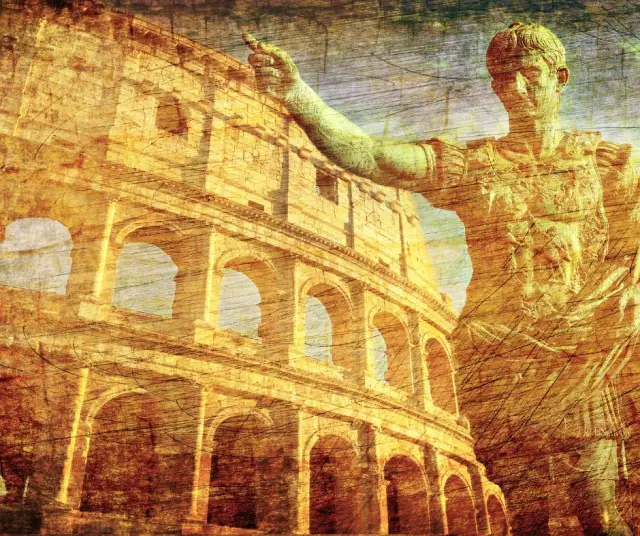
The Colosseum, formally known as the Flavian Amphitheater, is perhaps one of the most iconic symbols of the Roman Empire. Opened in 80 AD, it could accommodate more than 50,000 spectators. The games held there included gladiatorial combats, public executions, and re-enactments of famous battles, some of which involved flooding the floor of the Colosseum to simulate naval battles.
Society and Daily Life
Daily life in the Roman Empire varied considerably between social classes. Wealthy Roman citizens lived in luxurious villas decorated with mosaics and frescoes, enjoying banquets and entertainment. On the other hand, most Romans lived in modest insulae (apartment blocks). Typical food included bread, wine, olives and garum (a fermented fish sauce).
The Expanse of the Empire
At its peak, the Roman Empire spanned three continents: Europe, Asia and Africa. From the Scottish highlands to the Sahara Desert, and from the Iberian Peninsula to the shores of the Caspian Sea, the empire controlled a vast and diverse expanse of territory. This geographical diversity meant a great variety of cultures and peoples under Roman rule.
Roman Law
The Roman legal system has been one of the empire's most lasting contributions. Roman Law laid the foundation for many modern legal systems. The principles of justice, equity, and the right to a fair trial were fundamental in Roman jurisprudence. Documents such as the Corpus Juris Civilis, compiled under Emperor Justinian, still influence contemporary civil law.
Religion and the Roman Pantheon
The Roman religion was polytheistic, with a pantheon of gods and goddesses who played specific roles in the life and destiny of human beings. Jupiter, Juno, Mars and Venus were some of the most revered gods. The Empire eventually adopted Christianity as its official religion under Emperor Constantine in the 4th century, marking a significant change in the religious history of the Western world.
The Gladiators
Gladiators were trained combatants who entertained audiences with their fighting skills. Although many were slaves or prisoners of war, some were free citizens seeking fame and fortune. Gladiator combats were popular and complex events, involving specialized training and a variety of weapons and tactics.
The Fall of the Empire
The fall of the Roman Empire is a topic of debate among historians. The Western Empire is considered to have fallen in 476 AD when the last emperor, Romulus Augustulus, was deposed. However, the Eastern Roman Empire, known as the Byzantine Empire, continued to exist until the fall of Constantinople in 1453.
Innovations and Technological Contributions
The Romans made numerous technological innovations and contributions that have endured over time. In addition to their impressive roads and aqueducts, they introduced the use of central heating systems, such as the hypocaustum, used in Roman houses and baths. They also developed advanced techniques in medicine and surgery, with leading figures such as Galen making important contributions to medical knowledge.
The Latin Language
Latin, the language of the Romans, was not only the basis of the empire, but also influenced many modern languages. Spanish, French, Italian, Portuguese and Romanian, among others, are Romance languages that evolved from Latin. Additionally, many legal, scientific, and religious terms in English and other European languages have Latin roots.
Roman Art and Culture
Roman art, influenced by Greek culture, excelled in sculpture, painting and architecture. The Romans were known for their realistic portraits in busts and statues, as well as for their impressive frescoes that decorated the walls of villas and public buildings. Furthermore, Roman literature, with figures such as Virgil, Ovid and Cicero, continues to be studied and admired for its richness and depth.
The Roman Currency
The Roman monetary system was fundamental to the economy of the empire. Roman currency, especially the silver denarius and the gold aureus, was widely used in trade and had great stability. This monetary uniformity facilitated trade and economic growth throughout the empire.
The Role of Women in Rome
Although women in Rome did not enjoy the same rights as men, they played important roles in society. They could own businesses, manage property, and influence family and political life. Prominent women such as Livia Drusilla, wife of Emperor Augustus, had a significant impact on Roman history.
Food and Gastronomy
Roman gastronomy was varied and reflected the diversity of the empire. Roman banquets were famous for their opulence, and dishes such as stuffed dormouse (a type of rodent) and garum were considered delicacies. Apicio's "De re coquinaria" recipe book provides us with a detailed look at Roman cuisine.
The Roman Empire was a complex and multifaceted civilization that left a lasting legacy in numerous aspects of human life. The curiosities mentioned here are just a small sample of the rich and fascinating history of this legendary empire.