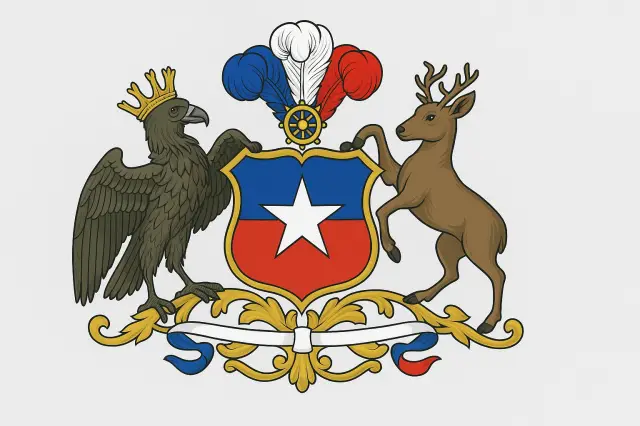
The National Coat of Arms of Chile is one of the country's most important emblems, along with the flag and the national anthem. It has represented the history, character, and values of the Chilean nation for over 180 years. Understanding its meaning is a way to better grasp the country's identity and roots.
Its current design was officially adopted in 1834 , during the government of José Joaquín Prieto , and created by the artist Carlos Wood Taylor , an Englishman living in Chile. Since then, the coat of arms has remained almost unchanged, symbolizing national pride and unity.
History and evolution of the National Coat of Arms
Before the design we know today, Chile had other coats of arms between 1812 and 1834, during the early years of independence.
The first one depicted a column with a star on top, a globe, and the phrase "Post Tenebras Lux" (After darkness, light). It represented the desire for freedom after Spanish rule.
Over time, the coat of arms changed until it consolidated the definitive symbols that reflect the geography, strength and spirit of the country.
👉 At CalendarioChile.com/blog you can also find articles related to national symbols , such as the history of the Chilean flag and Chilean national holidays .
Meaning of the elements of the National Coat of Arms
Each component of the National Coat of Arms has historical and symbolic value. Below, we explain its meaning and what it represents for the Chilean people.
Colors: blue, white, and red
The colors of the coat of arms are the same as the flag of Chile and evoke the three pillars of the country:
Blue : represents the sky and the Pacific Ocean, symbols of freedom and hope.
White : alludes to the snow of the Andes Mountains , a symbol of purity and dignity.
Red : remembers the blood shed by the heroes of independence, in honor of those who fought for freedom.
These colors are also arranged as a background on the shield, in two fields: blue and red, separated by a white stripe.
The white five-pointed star
The white star in the center is a constant emblem in Chilean history. It represents the unity of the State , sovereignty , and the guidance of the Chilean people toward the future.
Its presence also alludes to the motto of the liberators: "a star in the sky of America".
The condor and the huemul
On either side of the shield are two emblematic animals of Chilean fauna:
The condor : a symbol of strength, independence, and protection. It is the largest bird in the Andes and dominates the skies of South America. It represents power and freedom.
The huemul , a native animal of the southern Andes, represents the nobility, peace, and gentleness of the Chilean people. It is also a protected species and a symbol of the country's biodiversity.
The presence of these two animals, one winged and the other terrestrial, reflects the harmony between strength and nobility , as well as the diversity of the national territory.
The golden crowns
Above the heads of the condor and the huemul are golden crowns with tricolored feathers . These crowns represent the naval glory of Chile, in honor of its maritime triumphs and the importance of the ocean in national history.
The blue, white, and red feathers reinforce the national colors and the idea of sovereignty.
The rudder and the flag
Both animals hold the shield on a golden pedestal , a symbol of the national soil and the stability of the country.
The ensemble rests on a blue, white, and red banner , reinforcing Chilean national identity.
National motto “By reason or by force”
Under the shield appears the motto "By reason or by force" , a phrase that summarizes the history and character of the country.
Its most widespread interpretation is that Chile always seeks justice and peace through reason , but is prepared to defend its sovereignty if necessary. This motto represents balance, national pride, and determination in the face of adversity.
The National Coat of Arms today
Today, the National Coat of Arms is found on official documents, coins, public buildings, Armed Forces uniforms, and state institutions. It is also part of the oath of allegiance to the flag and the civic and school ceremonies held in September.
Furthermore, it is an educational symbol that is taught from childhood in schools, as part of learning about identity and patriotic values.
Interesting facts about the Chilean Coat of Arms
It was officially approved on June 26, 1834 .
Its original design was done in watercolor on paper by Carlos Wood Taylor.
In 1920 the shield was standardized with the current proportions.
The huemul is one of the most difficult species to observe in its natural habitat.
In 2013, a proposal was made to modernize it, but it was decided to maintain its traditional design out of respect for its history.
The National Coat of Arms as a symbol of Chilean identity
More than just an emblem, the National Coat of Arms of Chile is a living representation of its history, nature, and spirit . Every color, animal, and shape has a direct connection to the landscape, culture, and courage of its people.
Looking at the coat of arms, Chileans see reflected the diversity of the country: from the mountains to the sea, from the strength of the condor to the serenity of the huemul, united under a single star.