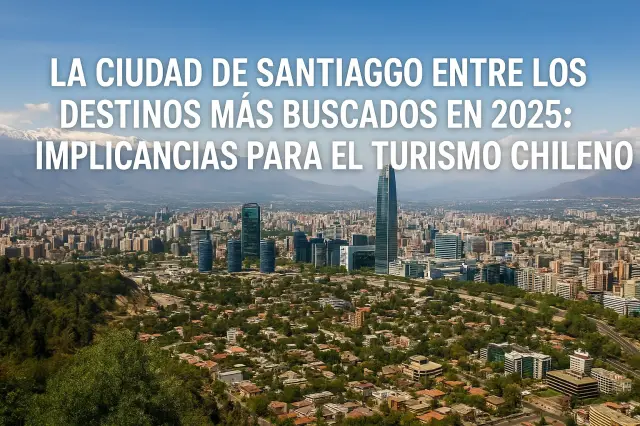
The keyword “Santiago de Chile destination 2025” is already included in this section to meet the early usage requirement.
The city of Santiago, Chile is positioning itself very strongly in 2025 as a high-demand tourist destination, which opens up both opportunities and challenges for the Chilean tourism sector.
On the one hand:
According to data from the Airbnb platform, between January and June 2025, searches for accommodations in Santiago grew by nearly 30% compared to the same period of the previous year. El Tiempo
Furthermore, a TripAdvisor review ranked it as a "Trending Destination" worldwide, reaching number 23, and number 10 in South America . National Tourism Service | SERNATUR
At the VYVA 2025 tourism fair, it is highlighted that the Santiago Metropolitan Region will be attending with an expanded tourism offering: nightlife, wine tourism, mountains, nature, and gastronomy as key elements. National Tourism Service | SERNATUR
These data show that Santiago is not only attractive because of its infrastructure or location: it is being rediscovered as a metropolis capable of combining city and nature, culture and urban experiences.
What factors explain this boom in Santiago in Chilean tourism?
Urban experience + nature
Santiago offers an attractive combination for travelers seeking both city life and quick getaways to the mountains or vineyards. The hills, heritage neighborhoods, vineyards of the Maipo Valley, and excursions to the Cajón del Maipo complement the city. viajeroscallejeros.com +2 Chile Travel +2
International recognition
Santiago and Chile's positioning as a "trending" or "growing" destination strengthens its international visibility. This recognition generates virtuous cycles: more searches, greater visibility, and more investment.
Established cultural and gastronomic offering
The Chilean capital has strengthened its offerings of gastronomy, bars, nightlife, and creative neighborhoods, attracting both leisure and cultural tourism. This allows Santiago to compete with similar cities in the region.
Infrastructure and connectivity
The fact that major platforms are identifying an increase in accommodation searches suggests that demand is translating into bookings or travel intentions. International access is easier, and there is ample hotel accommodation, transportation, and other services available.
Implications for Chilean tourism
1. Increased pressure on housing and urban services
The increase in searches and interest in Santiago means that accommodations, public transport, and tourist services—guides, tours, and gastronomy—will experience greater demand. This could create imbalances if the supply does not adapt.
Price increases
Overcrowding in certain neighborhoods or tourist routes
Need for better urban mobility planning
2. Revaluing Santiago as a gateway to national tourism
Santiago's status as a "must-visit" destination also positions it as a gateway for travelers who then wish to extend their trip to northern, southern, or rural areas of Chile. This creates a multiplier effect for other regions.
3. Opportunity to diversify urban tourism in Chile
With Santiago as the driving force, tour operators can offer "urban + nature/region" experiences: for example, getaways from Santiago to vineyards, mountains, lakes, coasts, which extends stays and average spending.
4. Need for sustainable tourism management
Growth demands addressing sustainability: mobility, accessibility, impact on residential neighborhoods, and a balance between tourism and local quality of life. If these are not managed well, the overload can lead to rejection or a decline in the experience.
5. Strengthened international marketing potential
The data showing increased search volume, rankings, and visibility allows Chile, and specifically Santiago, to strengthen its international tourism campaigns with credibility. This can attract high-value tourist segments, extend stays, and increase local spending.
What does it mean for the readers and visitors of your portal?
As a reader/user of CalendarioChile.com interested in tourism, culture and historical events, this phenomenon in Santiago offers multiple angles to explore:
Choosing when to visit : With high demand, it's advisable to book in advance, find out about less crowded times, or go down to less traditional neighborhoods.
Discover complementary routes : Beyond the historic center, explore emerging neighborhoods, vineyards of the Maipo Valley, mountain getaways from Santiago.
Understanding the local impact : How this tourism is experienced in the city, the interaction between residents and visitors, which neighborhoods benefit or suffer.
Prepare for quality experiences : Increased competition leads to higher service standards, so visitors can expect better infrastructure, better tours, and more specialization.
Practical recommendations for taking advantage of this growing destination
Book accommodation in advance, especially if you are traveling during peak season or with the intention of visiting special events (festivals, cultural events).
Choosing residential or up-and-coming neighborhoods to stay in, rather than just traditional tourist areas, can offer better value and a more authentic experience.
Include at least one day or half-day outside the city center: vineyards, mountains, nature near Santiago. This takes advantage of being in the capital.
Stay informed about urban mobility: public transport, access, congestion, so that the journey is smooth.
Visit official promotional media and regional blogs to discover less crowded routes and new panoramas.