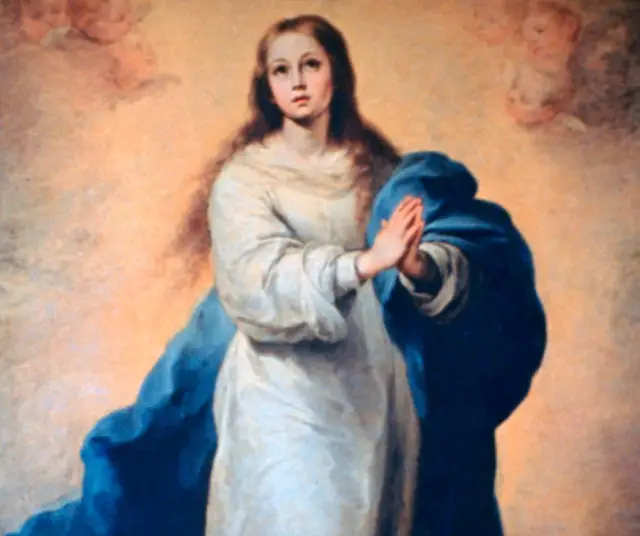
Immaculate Conception Day, celebrated on December 8, is one of the most important holidays in the Catholic liturgical calendar. This solemnity honors the belief in the sinless conception of the Virgin Mary, a fundamental dogma of the Catholic Church that was proclaimed by Pope Pius IX in 1854. In many countries, this day is also a national holiday and is marked by numerous traditions. religious and cultural.
Origin and Meaning of Dogma
The Doctrine of the Immaculate Conception
The doctrine of the Immaculate Conception holds that the Virgin Mary was conceived without the stain of original sin. This means that, from the first moment of her existence, Mary was preserved from the original sin that, according to Catholic theology, all human beings inherit. This belief is based on the idea that Mary had to be free of sin in order to be the mother of Jesus Christ, who is considered the Son of God and the Redeemer of humanity.
Proclamation of Dogma
On December 8, 1854, Pope Pius IX, through the papal bull Ineffabilis Deus, officially proclaimed the dogma of the Immaculate Conception. This act was the result of centuries of debate and theological development within the Church. In his proclamation, Pius IX declared:
“For the honor of the holy and indivisible Trinity, for the glory and ornament of the Virgin Mother of God, for the exaltation of the Catholic faith and the increase of the Christian religion, with the authority of our Lord Jesus Christ, of the blessed apostles Peter and Paul, and with ours, we declare, proclaim and define that the doctrine that maintains that the most blessed Virgin Mary was, from the first moment of her conception, by singular grace and privilege of omnipotent God, in anticipation of the merits of Jesus Christ, Savior of the genus human, preserved immune from all stain of original sin, is a doctrine revealed by God and, therefore, must be firmly and constantly believed by all the faithful.”
Theological Importance
The dogma of the Immaculate Conception emphasizes the uniqueness and purity of Mary, highlighting her special role in the history of salvation. By being conceived without sin, Mary is seen as the new Eve, the one who, unlike the first Eve, remained faithful to God's will. This unique privilege also highlights the mercy and grace of God, who prepared Mary for her special mission of being the mother of the Redeemer.
Celebrations and Traditions
Liturgical Celebrations
The Day of the Immaculate Conception is celebrated with solemn masses throughout the Catholic world. The liturgies of this day usually include biblical readings that highlight the purity and divine election of Mary. The Gospel of Luke, which narrates the Annunciation, is particularly significant, as it shows Mary humbly and faithfully accepting her role in God's plan of salvation.
Processions and Popular Devotions
In many countries, the Day of the Immaculate Conception is celebrated with processions and acts of popular devotion. In Spain, for example, it is common to see processions with images of the Virgin Mary, accompanied by songs and prayers. In other places, such as in some Latin American countries, living rosaries are organized, where the faithful gather to pray the rosary in honor of the Virgin.
National holidays
December 8 is also a holiday in many countries, including Spain, Italy and several Latin American countries. In these places, schools and government offices are usually closed, and the day is dedicated to religious celebration and family activities.
Cultural and Artistic Influence
Art and Architecture
The figure of the Virgin Mary and the theme of the Immaculate Conception have inspired numerous artists throughout the centuries. Painters such as El Greco, Murillo and Francisco de Zurbarán created some of the most famous representations of the Immaculate Conception, highlighting the purity and holiness of Mary. These works of art not only adorn churches and cathedrals, but are also part of the cultural heritage of many countries.
Music and Literature
The Immaculate Conception has also been a source of inspiration in music and literature. Composers such as Johann Sebastian Bach and Wolfgang Amadeus Mozart have composed pieces in honor of the Virgin Mary. In literature, poets and writers have celebrated the purity and devotion of Mary in their works, contributing to a rich Marian tradition in Western culture.
Historical Debates and Controversies
Historical Development of Dogma
The doctrine of the Immaculate Conception was not immediately accepted by all theologians and leaders of the Church. During the Middle Ages, there was intense debate over whether Mary had been conceived without original sin. Some theologians, such as Saint Bernard of Clairvaux, questioned this idea, while others, such as Duns Scotus, vehemently defended Mary's immaculate conception.
Reactions to the Proclamation of Dogma
The proclamation of the dogma in 1854 was received with enthusiasm by many faithful, but also met with resistance in some sectors. Some theologians and church leaders feared that this definition could cause divisions within the Church. However, over time, the doctrine of the Immaculate Conception has become widely accepted and celebrated in the Catholic world.
The Immaculate Conception in the Ecumenical Context
Perspectives of Other Christian Denominations
Belief in the Immaculate Conception is specific to the Catholic Church and is not shared by many other Christian denominations. The Eastern Orthodox, for example, venerate the Virgin Mary as the Theotokos (Mother of God) and believe in her purity, but do not accept the doctrine of the Immaculate Conception as defined in Catholicism. Similarly, many Protestant churches reject this doctrine, preferring to focus on other aspects of the Christian faith.
Interreligious Dialogue
Despite doctrinal differences, Immaculate Conception Day offers an opportunity for interfaith dialogue. Marian celebrations and devotions can serve as a bridge between different Christian traditions, fostering greater understanding and mutual respect.
The Immaculate Conception in the Life of the Faithful
For many Catholics, the Immaculate Conception is more than a theological doctrine; It is a source of comfort and hope. Mary, conceived without sin, is seen as a model of virtue and obedience to God. His example inspires the faithful to pursue a life of holiness and devotion.
Social and Cultural Impact
Immaculate Conception Day also has a significant impact on the social and cultural life of many communities. The festivities and traditions associated with this day reinforce community identity and cohesion, offering an opportunity for families and communities to come together in celebration.
The impact of this festival goes beyond the religious sphere, also influencing culture and society in numerous countries. In an increasingly plural and diverse world, Immaculate Conception Day continues to be an occasion to reflect on faith, grace and devotion, as well as to foster understanding and dialogue between different religious traditions.