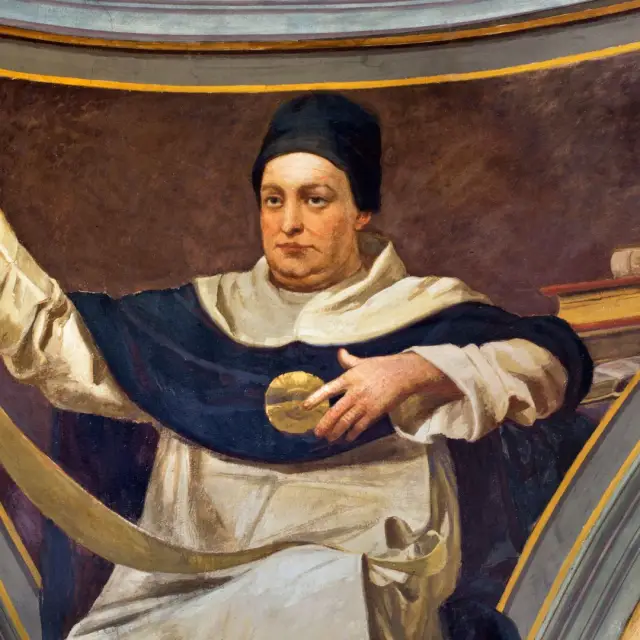
Saint Thomas Aquinas, born in 1225 in the castle of Roccasecca, near Aquinas, in Italy, is one of the most influential figures in the philosophy and theology of the Middle Ages. Known as the Angelic Doctor and the Common Doctor, his work has left an indelible mark on the Catholic tradition and on Western thought in general. Through his life and work, Aquinas became a bridge between classical philosophy and Christian theology, achieving a synthesis that has endured throughout the centuries.
Early Years and Training
Thomas Aquinas was born into a noble family. From an early age, he showed a great interest in knowledge and spirituality. At the age of five, he was sent to the Benedictine Abbey of Monte Cassino, where he began his formal education. His early immersion in monastic life and his exposure to the writings of the Church Fathers and classical philosophers laid the foundation for his future work.
At fourteen, Tomás entered the University of Naples, where he studied liberal arts, including logic, grammar, and rhetoric. It was here that Aquinas was introduced to the philosophy of Aristotle, which would have a lasting influence on his thinking. In 1244, despite his family's opposition, he joined the Dominican Order, a decision that marked the course of his life.
Philosophical and Theological Influences
The work of Thomas Aquinas is deeply influenced by Aristotle, whose thought, rediscovered and commented on by Islamic philosophers such as Averroes and Avicenna, was beginning to permeate medieval Europe. Aquinas saw in Aristotle a system of rational thought that could be reconciled with Christian doctrine. Through his writings, Thomas strove to demonstrate that faith and reason were not only not contradictory, but could complement each other.
In addition to Aristotle, Aquinas was also influenced by Augustine of Hippo, known as Saint Augustine. While Augustine had emphasized the primacy of faith over reason, Thomas sought to balance the two, arguing that reason could lead to a better understanding of faith. This synthesis would become the hallmark of his work.
The Summa Theologiae
The magnum opus of Saint Thomas Aquinas is the Summa Theologiae, a vast theological work encompassing all aspects of human and divine knowledge. The Summa is structured in three main parts: the first deals with God and creation; the second, about morality and human nature; and the third, about Christ and the sacraments.
The Nature of God
In the first part of the Summa, Thomas Aquinas presents his famous "five ways" to prove the existence of God. These tests, based on observation of the natural world, include the argument from motion, efficient causality, contingency, degrees of perfection, and teleological design. Through these arguments, Aquinas attempts to show that the existence of God can be known through natural reason.
Morality and Natural Law
In the second part, Aquinas addresses questions of ethics and morality, developing his theory of natural law. According to Thomas, natural law is the participation of the rational creature in the eternal law of God. This natural law, accessible through reason, guides human beings towards their ultimate goal, which is bliss in God. Thomistic ethics focuses on virtue and the common good, and its influence extends to contemporary moral philosophy.
Christ and the Sacraments
The third part of the Summa deals with Christ as mediator between God and man, and the sacraments as means of grace. Here, Thomas Aquinas lays out his doctrine of incarnation and redemption, arguing that Christ is the way to salvation. The sacraments, especially the Eucharist, are seen as divine instruments through which grace is communicated to the faithful.
The Philosophy of Science
Another significant contribution of Thomas Aquinas is his philosophy of science. Aquinas distinguishes between speculative sciences, which seek knowledge for knowledge's sake, and practical sciences, which seek knowledge in order to action. In his work De Magistro, Tomás explores the nature of knowledge and the teaching process, highlighting the importance of experience and reason in the acquisition of knowledge.
Controversies and Criticisms
Throughout his life and after his death, Thomas Aquinas's ideas were not without controversy. Some contemporaries, such as the Franciscans, criticized his use of Aristotelian philosophy, considering it incompatible with the Christian faith. However, over time, Aquinas's teachings were accepted and promoted by the Catholic Church, especially during the Council of Trent in the 16th century, which reaffirmed many of his doctrines.
Canonization and Legacy
In 1323, less than fifty years after his death, Thomas Aquinas was canonized by Pope John XXII. In 1567, Pope Pius V declared him a Doctor of the Church, and in 1879, Pope Leo XIII promoted his teachings as a basis for theological education in his encyclical Aeterni Patris.
The legacy of Thomas Aquinas is vast and enduring. Its influence extends beyond theology, affecting areas such as philosophy, ethics, natural law, and education. His works have been studied and commented on by generations of theologians and philosophers, and his thought remains relevant in the contemporary debate on the relationship between faith and reason.