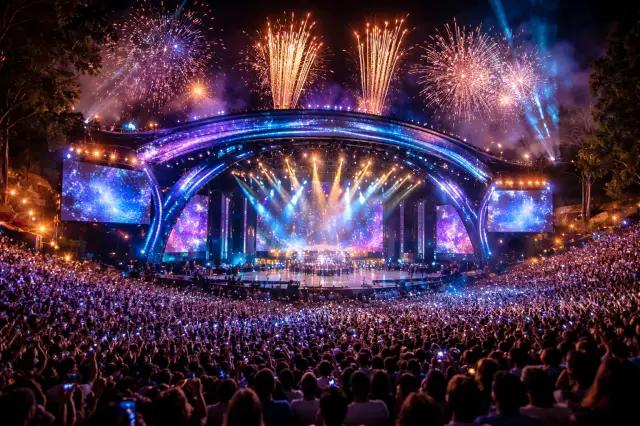
The Viña del Mar International Song Festival is one of Latin America's most iconic musical events and a beloved Chilean tradition. Its origins date back to 1960, when it began as a simple competition among local artists at the Quinta Vergara amphitheater , promoted by the Viña del Mar municipality and a group of visionaries seeking to promote Chilean music.
Over the years, the festival grew in production, audience, and international prestige. In the 1970s and 1980s, it established itself as a showcase for artists from all over Latin America, and in the 1990s, it achieved worldwide recognition thanks to its television broadcast on international networks.
Throughout its history, the festival has witnessed memorable performances, controversies, humor, romances, and moments that marked Chilean popular culture.
The symbol of the “Monster” of Quinta Vergara
One of the festival's most well-known icons is "The Monster," as the demanding audience that attends the Quinta Vergara amphitheater is nicknamed. From the early years, the energy of the crowd was such that artists could be cheered or booed with equal force.
Winning over the "Monster" has become both a challenge and an honor for every singer. Those who succeed are met with thunderous applause, while those who fail to connect with the audience face the dreaded chorus of disapproval. This unique interaction is part of the DNA of the Viña del Mar Festival.
Artists who marked the history of the Viña del Mar Festival
The Quinta Vergara stage has hosted international legends and Chilean talents who left their mark. Some unforgettable moments include:
Luis Miguel (1985 and 1994) : his performances set audience records.
Shakira (1993 and 2000) : arrived as a breakout artist and returned as a global star.
Ricky Martin (1993, 2014 and 2020) : Latin pop icon who conquered the Chilean public.
Mon Laferte : a Viña del Mar native who went from competing in the international category to being one of the most anticipated artists.
Yuri, Raphael, Chayanne, Alejandro Sanz and Juan Gabriel , among many others, are part of the musical legacy of this event.
In addition, the festival has been an important stage for promoting Chilean music , with figures such as Los Jaivas, Myriam Hernández, Los Tres and Los Bunkers , who represented the country's cultural identity.
The international and folkloric competitions
The original spirit of the Viña del Mar Festival has always been linked to musical competition. There are two categories:
International Competition , where artists from different countries present their original songs in search of the coveted Silver Seagull .
Folkloric Competition , which pays homage to Chilean and Latin American musical roots, being a key space to spread folklore and local traditions.
Both competitions are evaluated by a jury composed of artists, journalists and entertainment figures.
Interesting facts about the Viña del Mar Festival
The Viña del Mar Festival is full of anecdotes and curiosities that few people know:
In 1963, the Silver Seagull , the highest symbol of the competition, was awarded for the first time.
The public has been so influential that on more than one occasion it has managed to overturn jury decisions.
In 1981, Camilo Sesto broke the record for the most seagulls awarded in a single night.
In 2019, Bad Bunny created one of the most viral moments by stopping his show to talk about diversity and inclusion.
The festival has only been suspended twice in its history: during the pandemic in 2021 and 2022, which increased the anticipation for its return.
Viña del Mar Festival 2026: What to Expect
The 2026 Viña del Mar Festival promises to be a special edition, blending nostalgia and innovation. A lineup of national and international artists is expected, along with the presence of new generations of pop and urban music, and the incorporation of more advanced stage technology.
Furthermore, greater participation from the digital audience is expected, with interactive voting, live streams, and social media experiences. The Municipality of Viña del Mar has indicated that the focus will be on highlighting Chilean identity and providing a platform for new voices.
The competition will once again be broadcast by major television networks and streaming platforms, consolidating its position as one of the most watched events in Latin America.
Cultural and tourist impact of the Viña del Mar Festival
Beyond the music, the Viña del Mar Festival is a driving force for tourism and the local economy . Every year, thousands of visitors flock to the Garden City to enjoy the event and its tourist attractions: beaches, gastronomy, hills, and nightlife.
The festival also positions Chile as an international cultural destination , boosting the visibility of local artists and generating a sense of national pride.
Viña del Mar is transformed during that week: commerce picks up, hotels reach full occupancy and the city dresses up for the festivities, becoming the epicenter of the Chilean summer.
Iconic presenters and television moments
The history of the festival cannot be told without mentioning its hosts . Figures such as Antonio Vodanovic, Cecilia Bolocco, Felipe Camiroaga, Rafael Araneda, and Carolina de Moras left their mark on the stage.
The pairing of hosts is a hallmark of the event, generating excitement every year. In 2026, the return of beloved Chilean entertainment personalities is expected, combined with new figures from television and social media.
Among the most memorable moments are the tribute to Felipe Camiroaga in 2012 , the social speeches of artists such as Mon Laferte and Residente, and the historic "rating lows" reached during the 90s.
The influence of the Viña del Mar Festival on Latin music
The Viña del Mar Festival has been a launching pad for numerous artists who later achieved international success. Winning or even just participating in the competition can change a career.
Furthermore, Viña has served as a barometer of Latin music , reflecting trends and social changes. From bolero and ballads to reggaeton and urban pop, the Quinta Vergara stage has witnessed the musical evolution of an entire continent.