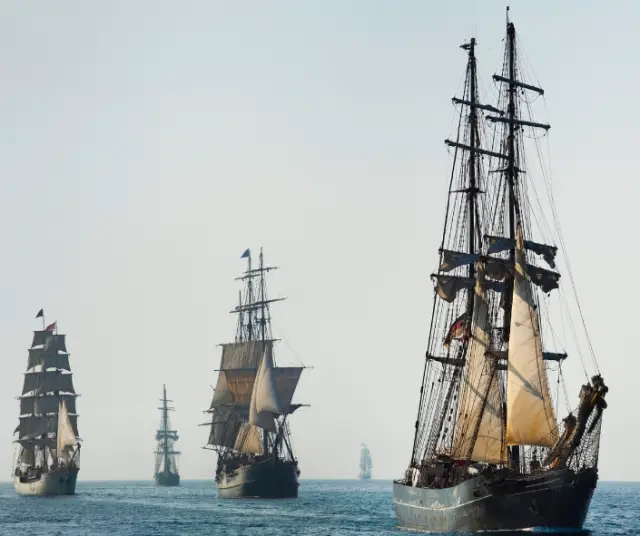
The Combat of Papudo, fought on November 26, 1865, was a key naval confrontation during the War against Spain in the context of the War of the Pacific. This battle took place off the coast of Papudo, Chile, and pitted the Chilean squadron led by the corvette Esmeralda against the Spanish fleet led by the frigate Covadonga.
Historic context
The Combate de Papudo took place within the framework of the War of the Pacific, a conflict that pitted Chile , Peru and Bolivia against Spain. Spain sought to regain its dominance in Latin America, while Chile and its allies defended their independence and sovereignty. The war took place in the context of the struggles for the emancipation and consolidation of the new Latin American states. In the 1860s, relations between Spain and Chile deteriorated due to trade disputes and political tensions. Spain, in an attempt to regain its influence in Latin America, decided to retaliate against Chile and the other nations involved in the War of the Pacific. This series of events culminated in the Combat of Papudo, one of the most important naval battles of the war.
protagonists
In the Combat of Papudo, the main protagonists were the Chilean corvette Esmeralda, commanded by Captain Arturo Prat, and the Spanish frigate Covadonga, led by Captain Manuel Villar.
Captain Arturo Prat, considered a national hero in Chile, was a prominent naval officer and a key figure in the resistance against the Spanish invasion. Born on April 3, 1848 in the city of Concepción, Prat stood out from an early age for his dedication and courage. He entered the Naval School in Valparaíso and graduated with honors, demonstrating a deep commitment to the defense of his country.
development of the battle
The battle began when the Spanish fleet tried to blockade the port of Valparaíso in an attempt to weaken the Chilean defenses. The corvette Esmeralda, despite being at a clear disadvantage in numbers and weapons, bravely faced the frigate Covadonga and other Spanish ships. Captain Arturo Prat and his crew, aware of the inequality of forces, prepared for battle with determination and courage. Despite the obstacles and the enemy's superiority, the Esmeralda maintained a fierce resistance and caused significant damage to the Spanish fleet. Prat, leading by example, inspired his men to fight with courage and dedication.
However, Covadonga finally managed to immobilize Esmeralda and board her. During the hand-to-hand confrontation, Captain Prat and a large part of his crew lost their lives. Although the corvette was captured by the Spanish, the heroism and sacrifice of Prat and his crew left an indelible legacy in the fight for independence and the defense of the homeland.
Legacy and consequences
Although the battle resulted in the capture and subsequent sinking of the Esmeralda, the Combate de Papudo became a pivotal moment in Chilean history and a symbol of bravery and sacrifice. The heroism of Captain Arturo Prat and his crew in defending the homeland became an inspiration for future generations.
The Combate de Papudo also had a significant strategic and political impact. Despite the defeat, Chile's resistance and determination in the face of the Spanish invasion strengthened the country's position in the war and consolidated its fight for independence. The bravery displayed by Prat and his crew on Papudo became a symbol of national identity and a reminder of the sacrifice required to maintain freedom and sovereignty.
Tributes and commemorations
The Combate de Papudo is commemorated annually in Chile on May 21, as part of the celebrations of the Day of Naval Glories. During this day, homage is paid to the heroes of combat and the values of bravery, loyalty and patriotism that they represent are highlighted.
The figure of Captain Arturo Prat and the Combate de Papudo are remembered and honored throughout the country through monuments, squares and streets that bear his name. One of the most outstanding tributes is the Monument to the Heroes of Iquique , located in Plaza Sotomayor in Valparaíso, which commemorates the brave men who lost their lives in the Papudo Combat. In addition to the monuments, the legacy of Arturo Prat and the Combate de Papudo extends through education and culture in Chile . In schools, Prat's bravery and patriotism is taught as an example to follow. There are also theatrical performances, works of art and exhibitions that recreate the battle and honor the heroes of that day.
In the military field, the Chilean Navy considers Arturo Prat as an icon of honor and courage. The Arturo Prat Naval School, located in Valparaíso, bears his name and is dedicated to training future generations of sailors, transmitting the values that Prat embodied during his life.
The Combate de Papudo, although a defeat in military terms, became a moral victory for Chile and a symbol of resistance and courage. The battle demonstrated the country's determination to defend its independence and its fight for sovereignty. The figure of Arturo Prat , along with the other heroes of the fight, continues to be remembered and revered in Chile as a symbol of bravery and sacrifice for the sake of freedom.