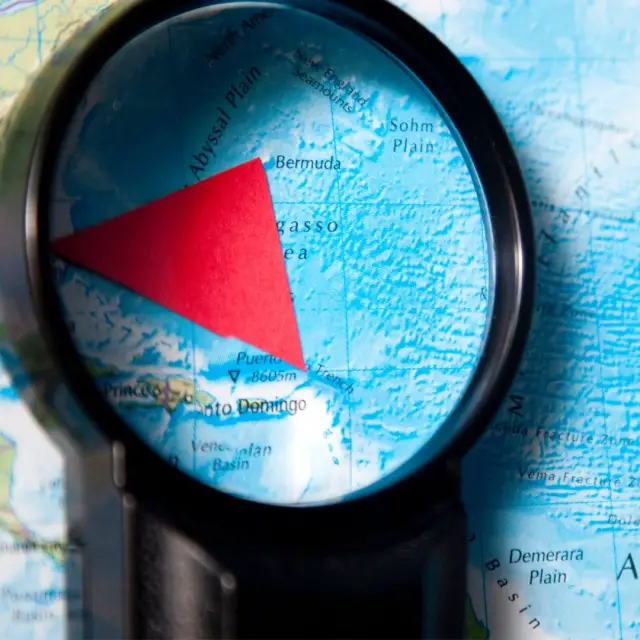
The Bermuda Triangle, also known as the "Devil's Triangle," is one of the most mysterious and fascinating regions in the world. Located in the Atlantic Ocean, this imaginary triangle is delimited by three points: Miami (Florida), San Juan (Puerto Rico) and the Bermuda Islands. Over the years, this area has been the scene of numerous unexplained incidents, including disappearances of ships and planes.
History and Origins of Myth
The myth of the Bermuda Triangle began to take shape in the first half of the 20th century. The first known reference to the area in mysterious terms appeared in a 1950 article by Edward Van Winkle Jones, published in the Miami Herald. In his article, Jones mentioned several incidents in which ships and planes had disappeared without a trace. Two years later, George X. Sand wrote an article for "Fate" magazine detailing more unexplained disappearances, further solidifying the mystery around the area.
The true rise of the Bermuda Triangle as a cultural phenomenon occurred in 1964, when Vincent Gaddis published an article titled "The Deadly Bermuda Triangle" in "Argosy" magazine. Gaddis, and later other authors such as Charles Berlitz, amplified the stories of disappearances, attributing them to mysterious and paranormal causes. In 1974, Berlitz published his book "The Bermuda Triangle", which became a bestseller and cemented the region's fame as a place full of enigmas.
Famous Cases
Flight 19
One of the most famous incidents associated with the Bermuda Triangle is "Flight 19." On December 5, 1945, a squadron of five United States Navy TBM Avenger bombers took off from Fort Lauderdale Air Base, Florida, for a training mission. The flight leader, Lieutenant Charles Taylor, reported problems with his navigation instruments. According to radio communications, the pilots became disoriented and eventually ran out of fuel. All the planes and the 14 crew members disappeared without a trace. A rescue plane sent to search for Flight 19 also disappeared with its 13 crew members, which increased the mystery and notoriety of the case.
The SS Marine Sulfur Queen
In February 1963, the tanker SS Marine Sulfur Queen sailed from Beaumont, Texas, bound for Norfolk, Virginia, carrying liquid sulfur. On February 4, the ship sent its last communication before disappearing without a trace along with its 39 crew members. Despite extensive search operations, no remains of the ship or crew were found. This case became one of the most enigmatic in maritime history.
The Star Tiger and the Star Ariel
Two commercial airliners, the Star Tiger and the Star Ariel, also disappeared in the Bermuda Triangle less than a year apart. The Star Tiger disappeared on January 30, 1948, on a flight from the Azores to Bermuda, with 31 people on board. The Star Ariel, with 20 people on board, disappeared on January 17, 1949, on a flight from Bermuda to Kingston, Jamaica. Despite intensive searches, no remains of any of the planes were ever found.
Scientific Theories
Climate Variability
One of the theories most accepted by the scientific community is that the climate in the Bermuda Triangle region is highly variable and can change rapidly. Thunderstorms, hurricanes and other extreme weather events are common in this area of the Atlantic. These conditions can wreak havoc on navigation and have been responsible for numerous shipwrecks and aircraft accidents.
Ocean Currents
The Bermuda Triangle is located in a region of the ocean where several ocean currents converge, including the Gulf Stream. These currents can be extremely strong and can carry ship and aircraft debris great distances in a short time. This could explain why, in many cases, remains from shipwrecks or plane crashes are not found.
Formation of Methane Bubbles
Another interesting theory is the release of large bubbles of methane from the ocean floor. Research has shown that at the bottom of the Atlantic there are large deposits of methane hydrates. If these bubbles are released suddenly, they could reduce the density of the water and cause ships to sink quickly. However, evidence that this occurs on a scale that significantly affects maritime and air traffic in the Bermuda Triangle is limited.
Magnetic Anomalies
The Bermuda Triangle is known for its magnetic anomalies, where compasses sometimes point to true north instead of magnetic north. This can cause navigation confusion, especially in the era before GPS technology. These variations in the Earth's magnetic field may be due to mineral deposits on the ocean floor or to complex interactions between the Earth's magnetic field and the atmosphere.
Paranormal Theories and Speculations
Extraterrestrial Activity
One of the most popular and speculative theories is the intervention of extraterrestrials. Proponents of this theory suggest that the Bermuda Triangle could be a place where aliens hijack ships and planes to study them. This idea has been fueled by numerous books, films and television shows that have explored the possibility of contact with beings from other planets.
Interdimensional Portals
Another theory is the existence of interdimensional portals or "vortices" in the Bermuda Triangle. According to this hypothesis, the disappearances could be the result of ships and planes accidentally passing through doors to other dimensions or times. Although this theory is highly speculative and lacks scientific evidence, it has captured the imagination of many people.
The Lost Continent of Atlantis
Some conspiracy theorists suggest that the Bermuda Triangle is the site of the legendary lost continent of Atlantis. It is said that remnants of advanced Atlantean technology, such as energy crystals or ancient machines, could be interfering with modern ships and planes, causing their disappearances. This theory, although romantic and fascinating, is considered by most scientists to be a baseless myth.
Studies and Denials
Research by Larry Kusche
In 1975, author and researcher Larry Kusche published a book titled "The Mystery of the Bermuda Triangle: Solved." Kusche reviewed numerous cases associated with the Triangle and concluded that many of them had been exaggerated or misinterpreted. In his research, Kusche discovered that some ships and planes had disappeared not in the Triangle, but in places outside the area's traditionally accepted boundaries. Furthermore, many disappearances could be explained by natural causes or human error.
The US Coast Guard Report
The United States Coast Guard has also conducted investigations into the incidents in the Bermuda Triangle. In its reports, the Coast Guard has not found any evidence of supernatural or unexplained phenomena. According to their analysis, the majority of disappearances can be attributed to adverse weather conditions, mechanical failures, navigation errors and other factors common in maritime and air navigation.
Modern Scientific Studies
Modern scientific studies continue to rigorously examine the Bermuda Triangle. Advanced technology, such as satellites and sonar, has allowed researchers to map the ocean floor more accurately and track weather patterns and currents. So far, science has not found any conclusive evidence that the Bermuda Triangle is more dangerous than any other part of the Atlantic Ocean.
The Bermuda Triangle remains one of the most enduring mysteries of our time. Despite numerous theories and explanations, both scientific and speculative, the area continues to capture the public imagination. While some see the Triangle as an unsolved enigma, others believe that advances in science and technology will eventually unlock all of its secrets. Until then, the Bermuda Triangle will remain a symbol of the unknown, a reminder that our world still holds many mysteries to discover.