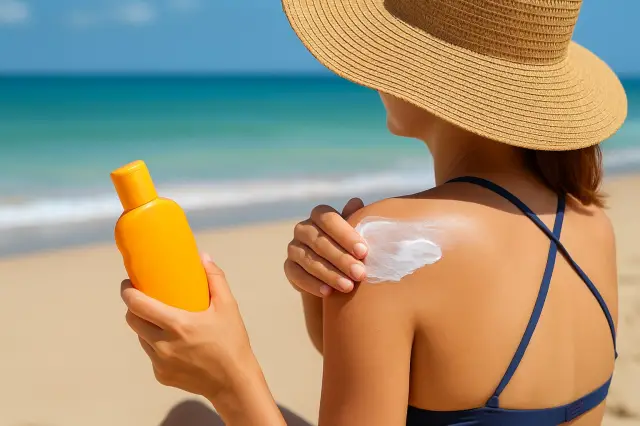
Summer in Chile is becoming increasingly intense. High temperatures and increased ultraviolet (UV) radiation have made sun protection a daily necessity, especially in northern and central regions where UV indices exceed the levels recommended by the World Health Organization (WHO).
In recent years, the Ministry of the Environment and the Ministry of Health have strengthened campaigns to promote the use of sunscreen and responsible sun exposure habits. However, many myths persist about how, when, and how much sunscreen to use.
Common myths about sun protection
“I only need sunscreen when I go to the beach.”
False. UV radiation does not depend on temperature or location. In cities like Santiago, Antofagasta, or Temuco, the level of radiation can be the same as, or even higher than, on the coast.
Daily exposure—walking, driving, or working outdoors—also causes cumulative damage to the skin. That's why dermatologists recommend applying sunscreen every day of the year , even on cloudy days.
"The higher the SPF, the longer I can stay in the sun."
Another widespread myth. SPF (Sun Protection Factor) indicates how much UVB radiation a product blocks, but it does not determine the total safe exposure time .
For example:
SPF 30 filters approximately 97% of UVB rays.
SPF 50 achieves approximately 98% .
The real difference is minimal, so the most important thing is to reapply the sunscreen every 2 or 3 hours , especially if there is sweat or contact with water.
“Dark skin tones don’t need sunscreen”
False. Although darker skin tones have more melanin, they are not immune to sun damage . UV rays can cause spots, premature aging, and skin cancer in any skin tone.
In Chile, dermatologists at the Clinical Hospital of the University of Chile have warned that skin cancer is the most frequently diagnosed type of cancer in the country. Using sunscreen is an essential preventative measure for everyone.
“If I use makeup with sunscreen, I don’t need sunscreen.”
Incorrect. Makeup with SPF is a complement, but it does not replace facial sunscreen .
The amount of foundation or powder applied is far less than the dose needed to achieve the protection indicated on the label. Therefore, it's best to use sunscreen before applying makeup and reapply with spray or powder products throughout the day.
“There is no risk of sunburn on cloudy days.”
False. Up to 80% of UV radiation penetrates clouds , so even on gray days or days with coastal fog there is a risk of sun damage.
Due to its latitude and depleted ozone layer, Chile experiences high levels of radiation even on cloudy days. Therefore, sunscreen should be part of your daily routine, regardless of the weather.
Truths you should know about sun protection
Reapplication is more important than SPF
One of the most common mistakes is applying sunscreen only once a day. Sun protection loses effectiveness with sweat, water, or friction.
Reapply every 2 hours .
Use a generous amount (approximately one teaspoon for face and neck).
If you're at the beach or pool, choose water-resistant products.
Sunscreens expire
Yes, and using an expired product drastically reduces its effectiveness .
Always check the expiration date and avoid storing sunscreens from one summer to the next. Extreme heat and prolonged sun exposure alter their formula.
Clothing and accessories also protect from the sun
Sun protection isn't limited to sunscreen. Wide-brimmed hats, sunglasses with UV protection, and clothing made with UV-protective fabric are essential allies.
In Chile there are local brands that offer clothing with certified UV protection , especially useful for outdoor activities or work in exposed areas.
Children need special care
Children's skin is more sensitive to the sun. It is recommended that:
Avoid direct exposure between 11:00 and 16:00 .
Use sunscreen with SPF 50 or higher .
Choose hypoallergenic and fragrance-free products.
In addition, the use of hats, shirts with sleeves, and maintaining good hydration should be reinforced.
How to choose the right sunscreen in Chile
Chile has a wide variety of climates, from the Atacama Desert to Patagonia. Therefore, the choice of sunscreen should be adapted to each region.
| Region | Climate type | Protector recommendation |
|---|---|---|
| North (Arica, Antofagasta, Iquique) | Dry and with extreme radiation | Gel or fluid with SPF 50+ and a mattifying effect |
| Central Zone (Santiago, Valparaíso) | Hot and urban | Facial sunscreen with antioxidants and a light texture |
| South (Valdivia, Osorno, Puerto Montt) | Humid and cloudy | Moisturizing cream with SPF 30 or higher sunscreen |
| Mountain range and snow zones | High UV exposure | Waterproof sunscreen with zinc or titanium dioxide |
The role of climate change and UV radiation in Chile
According to data from the Ministry of the Environment , Chile has experienced a sustained increase in UV radiation levels in recent years. This is due to the thinning of the ozone layer and the increase in clear days during the summer.
The phenomenon of extreme heat , which we already discussed in the article "How extreme heat is changing holidays in Chile" , reinforces the need to protect the skin and avoid prolonged exposure.
Furthermore, studies from the University of Santiago indicate that northern cities register UV indices of up to 11 or 12 points , considered "extreme" by the WHO.
Healthy habits to protect your skin all year round
Using sunscreen in the summer is not enough. Prevention should be a permanent habit.
Avoid direct sunlight between 11:00 and 16:00 .
Wear hats, sunglasses, and long-sleeved clothing.
Apply sunscreen even if you work indoors with large windows or screens .
She prefers products with combined physical and chemical filters .
Check your moles and consult a dermatologist once a year.
Technology and innovation in sunscreens
The Chilean market is incorporating new cosmetic technologies . There are sunscreens with antioxidant ingredients, biodegradable formulas, and products specially designed for athletes or those with sensitive skin.
In 2026, the launch of eco-friendly lines is expected, which reduce the environmental impact on beaches and rivers, aligned with the responsible consumption trends that we have already addressed in “Regulation of textile waste in Chile and its impact on fashion, culture and the environment” .