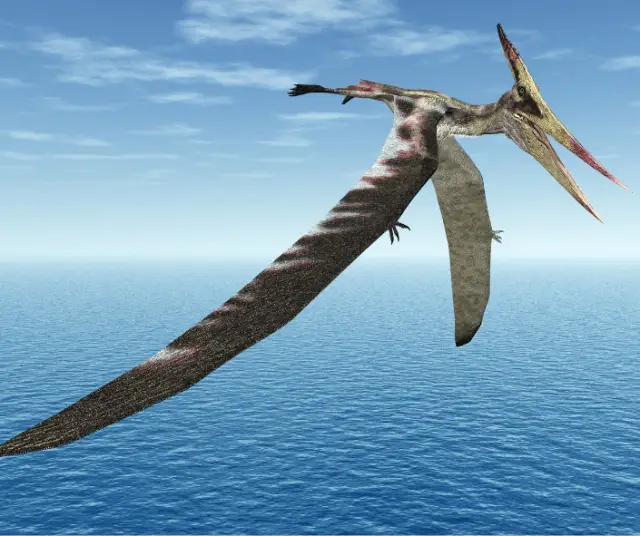
In the world of dinosaurs and prehistoric creatures, one often thinks of the mighty land reptiles that dominated the Earth millions of years ago. However, there is an equally fascinating and remarkable group of gravity-defying creatures: pterosaurs. Pterosaurs, also known as flying reptiles, are winged reptiles that lived during the Mesozoic era.
Anatomy and adaptations of pterosaurs
Pterosaurs had a unique anatomy that allowed them to fly. Its wings were made of a skin membrane stretched between its elongated fourth finger and the side of the body. In addition to wings, they had legs adapted for walking, climbing, or grasping objects. Some species had long tails that gave them stability in flight. Its skull featured a specialized structure with a pointed beak and sharp teeth, adapted to its diet .
diversity of pterosaurs
Pterosaurs spanned a wide range of sizes and shapes. Some species were small, with a wingspan of only a few centimeters, while others reached gigantic dimensions, with wingspans of more than 10 meters. Additionally, pterosaurs with various head shapes, crests, and colors have been discovered, suggesting great diversity in their appearance. This variety of sizes and shapes indicates an adaptation to different ecological niches.
lifestyles and behavior
Pterosaurs played various roles in ecosystems in the past. Some species were predatory, using sharp teeth to capture prey, while others ate fish or were scavengers. Some pterosaurs inhabited coastal areas and specialized in catching fish in flight, while others lived in terrestrial habitats and fed on insects and small vertebrates. Furthermore, some pterosaurs are believed to have migrated long distances in search of food and favorable weather conditions.
Evolution and extinction of pterosaurs
Pterosaurs evolved during the Triassic period, reaching their peak during the Jurassic and Cretaceous periods . However, at the end of the Cretaceous period, along with the mass extinction that also affected the dinosaurs, the pterosaurs became extinct. The exact reasons for their disappearance are still debated among scientists, but several theories have been put forward, including changes in climate, competition with early birds, and a lack of adaptability to new environments.
Pterosaurs played an important role in evolutionary history and in understanding ancient ecosystems. Through pterosaur fossils, scientists have been able to piece together details about life in the Mesozoic era, including the interaction between different species and changes in climate and environment. In addition, their unique anatomy and adaptations have provided valuable information on the evolution of flight in animals and have served as inspiration for the design of aerospace technologies.
Pterosaurs are fascinating creatures that defied gravity and ruled the skies for millions of years. Their unique anatomy, diversity, and adaptations have left an important legacy in evolutionary history. Through scientific research and the study of fossils , we continue to discover more about these incredible flying reptiles and their role in ecosystems of the past. Pterosaurs are impressive proof of the diversity and adaptability of life on our planet.